
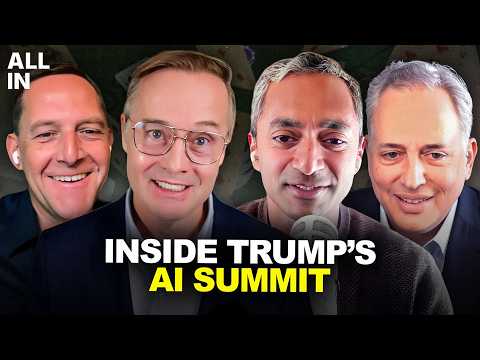
Trump’s Super Intelligence Summit, AI Safety Accord, GDP Beats, Midterm Predictions
The hosts argue that the White House accord makes AI safety governance practical without pausing development, that compute and power are national security assets, and that doomerism and media narratives distort the economy and politics.
Watch on YouTube ↗Charlie's summary
- ▶ 2:47
The White House Accord on Superintelligence is voluntary but has teeth through auditors, board committees, and D&O liability
Sax describes the accord as a voluntary agreement signed by six frontier labs. It has companies accept responsibility, run internal controls, and have external auditors verify them. An independent board committee receives the reports, and the board has a fiduciary duty to act on them. The FTC and SEC can enforce the public commitments. Sax says it needs no new legislation or international deal, so it is “very practical and it's immediate.”
- ▶ 11:10
Superintelligence needs an audit stack: end-to-end traceability, policies mapped to risk, and auditable evidence
Chamath says his firm 8090 is building audit infrastructure for superintelligence with Ernst & Young as its first customer. Companies need to trace what deployed AI is doing, map it to policies and risks, and keep evidence they can show a lawyer, regulator, auditor, or customer. He contrasts this with the alternative of pausing “trillions of dollars of GDP” to sort it out in a multinational body.
- ▶ 20:02
Regulating models is futile, so defense spending will rise and governments will end up allocating compute
Freeberg says open-weight models, 197 sovereign countries, and cheap local hardware make centralized control a fool's errand. He predicts cyber defense will become a board-level priority and an AI arms race. In 12 to 18 months he expects the debate to move from scoring models to governments allocating GPUs and inference across finance, defense and other sectors, because machine count decides who wins the defense race.
- ▶ 24:10
The US lost the muscle to double its power grid every decade, and anti-data-center sentiment is misguided
Freeberg notes that China is doubling its grid every decade while the US has been flat for about 25 years, though the US once doubled its grid each decade through the 20th century. He ties the flatline to deindustrialization and offices needing less power. He argues data centers serve the whole internet, so blaming them for specific applications is wrong. If privacy or surveillance is the worry, he says to strengthen privacy laws instead of banning data centers.
Give your email to unlock the rest of the key points — for every episode.
Do more with Charlie
Free — sign in with your email, no password.