
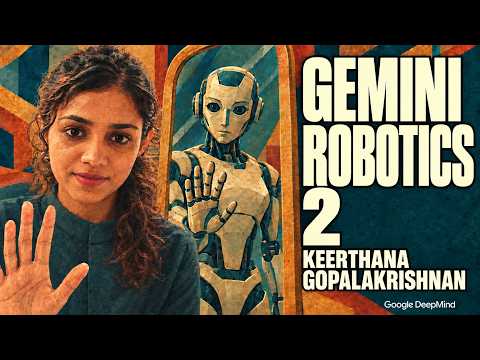
One Brain, Any Body: Google DeepMind's Keerthana on Gemini Robotics 2, Cross-Embodiment & Humanoids
Keerthana argues robotics is still in its GPT-2 era: locomotion is easy in simulation, while general manipulation, cross-embodiment transfer and reliable orchestration remain open, so she favors empirical mixtures over firm predictions.
Watch on YouTube ↗Charlie's summary
- ▶ 6:51
Robots outrunning Usain Bolt is easy because locomotion trains in simulation; contact-rich manipulation is the hard part
Keerthana says locomotion has advanced far because simulation handles it well: flat ground and walls are easy to model. Manipulation depends on contact, and that is where simulators break down. Cloth folding is harder because of friction and deformation, while rigid pick-and-place is largely solved. Where the physics is easy to model, “simulation gets in.” She and her team focus on useful work rather than foot speed.
- ▶ 14:55
Generality lifts all boats: build a broad baseline first, then climb to mastery on each task
Keerthana treats generalization and mastery as orthogonal axes. A narrow AI can master one or two things, but then the cost of the nth task equals the cost of the first. A general baseline makes tuning toward mastery much cheaper, as happened with LLMs, where GPT and Gemini beat specialized models. She thinks the same thesis may hold for robotics.
- ▶ 17:32
Robotics is still at GPT-2 because a generic brain must work across robot bodies
Keerthana scores the field at GPT-2. GPT-3 would need few-shot learning to work across many tasks, and robot models are still tied to the body they were trained on. Language models behave similarly on any phone or computer, but a robot brain that is helpless on a new robot is not generic. She sees one-shot demos as a form of video prompting. These models also tend to memorize and copy a demo, and the real test is whether they adapt when the scene changes.
- ▶ 24:26
The system-two/VLA split: ER2 reasons and calls tools, the VLA moves the body, and errors compound between them
Keerthana describes Gemini Robotics ER as a reasoning brain built on the Flash line, available via API. The VLA controls the actions, and an on-device version fits on the robot. Speed depends on the application: she would wait for laundry to be folded well, but assembly lines cannot wait. Failures often come from orchestration and latency between the two models. With tasks in sequence, the ER success rate and the VLA success rate multiply, so errors compound.
Give your email to unlock the rest of the key points — for every episode.
Do more with Charlie
Free — sign in with your email, no password.