
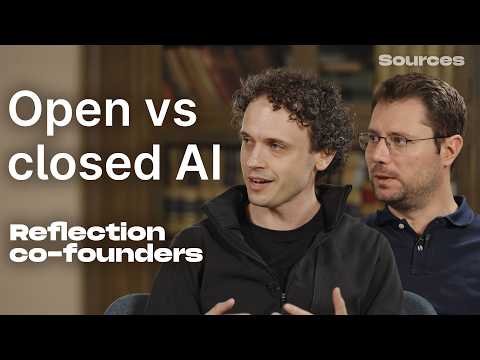
An open model challenger to Anthropic and OpenAI
Reflection's founders argue that open models are becoming the 'ownership' market for AI, and that a Western open frontier, built from scratch with heavily scaled RL, is both commercially viable and safer.
Watch on YouTube ↗Charlie's summary
- ▶ 0:28
Closed models are the rental market for intelligence; open models are the ownership market now arriving
Misha uses a real estate analogy. The commercial AI market is only about three years old and began as a rental market. As startups grew into giant enterprises, ownership started to matter. Open is the only way to own intelligence, because you can run it on your own stuff, control it and customize it. Misha says OpenRouter and Vercel token share flipped from roughly 30% open to roughly 70% open in six months.
- ▶ 6:07
The West lost open models because the rental market gave no commercial incentive, while China's push was geopolitical
Misha's armchair view is that Western development follows commercial incentives, and an early rental market supported closed models. Llama 3 was the peak of American open models, but nobody had a real commercial reason to keep going. China, he thinks, saw a concentrated, geopolitically motivated push after the DeepSeek V3 moment. Those labs made little money until recently.
- ▶ 8:42
Beam is a roughly 500B-parameter model (23B active) that is built for reasoning efficiency
Beam has about 500B total parameters and 23B active. Reflection says it is strong in coding and agentic benchmarks. Yiannis says it can be three or four times more token-efficient than some open models, and that it scales reinforcement learning to the highest compute levels publicly known among open labs. Misha says efficiency means faster responses and much lower serving costs, which matters most for consumer use cases.
- ▶ 14:16
Training from scratch was necessary to keep scaled RL stable
Reflection did not distill. Yiannis says that to scale reinforcement learning on a mixture-of-experts model while keeping the router and experts balanced and stable, you have to fully own pre-training. Reflection shaped the pre-training data to seed reasoning that RL then picks up, and tuned the architecture and optimization for stability. He argues this end-to-end optimization is how you pack a lot of intelligence into a smaller form factor.
Give your email to unlock the rest of the key points — for every episode.
Do more with Charlie
Free — sign in with your email, no password.