
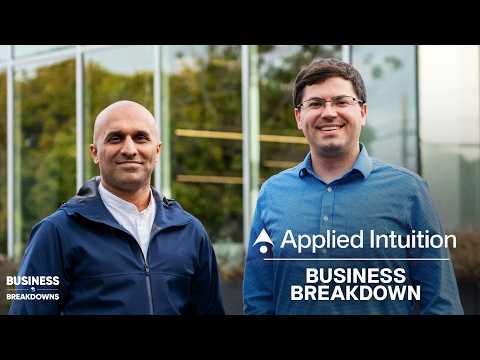
The Nvidia of Physical AI: Inside Applied Intuition's $15B Business
Applied Intuition's founders argue physical AI is a far larger market than digital AI, and that a horizontal tools-plus-intelligence platform, now extended by the Dana agent platform, is the way to serve it.
Watch on YouTube ↗Charlie's summary
- ▶ 1:33
Physical AI is a different problem from digital AI: safety, hard real-time limits, and a cost envelope
Peter says a chatbot can take 20 seconds to answer, but a car on a highway or a humanoid has hard real-time constraints. Machines also move among humans, so safety is critical. Compute must fit affordable silicon, so you can't “just throw endless compute” at it. Peter calls the dollars an underreported aspect of physical AI.
- ▶ 3:44
Physical AI will matter most where jobs are worst and labor is scarce, and the founders think it will dominate
Qasar contrasts the hand-wringing over digital AI with physical AI, where “the AI can't get there fast enough.” The average American farmer is 58, long-haul trucking is short of workers, and mining is 1% of the workforce but 8% of work-related fatalities. He expects physical AI companies to dominate minds 25 years from now. He also notes automotive alone is about 3% of global GDP.
- ▶ 13:46
Timing is everything: most startups fail by being too early, so the founders chose tools over robotaxis
Qasar, a former Y Combinator COO, says being too early burns money waiting for the market and is the default failure case. In the early 2010s he and Peter concluded a robotaxi company would be too early on both technology and business model. They expected the Teslafication of automotive, and began with tools because manufacturers wouldn't buy safety-critical software from a young company.
- ▶ 18:00
Be horizontal like Nvidia, not vertical like Tesla: build for one industry, reuse in the next
Peter says that with the technology shifting roughly every two years, a horizontal approach avoids overexposure to any one implementation. Tools hit an operating-system bottleneck, which pulled the company into deploying software and then the autonomy stack. Qasar says automotive work carries over to defense, then to construction and mining. He cites about $1 billion raised and never touched as proof, despite early advice that tools were a bad business.
Give your email to unlock the rest of the key points — for every episode.
Do more with Charlie
Free — sign in with your email, no password.