
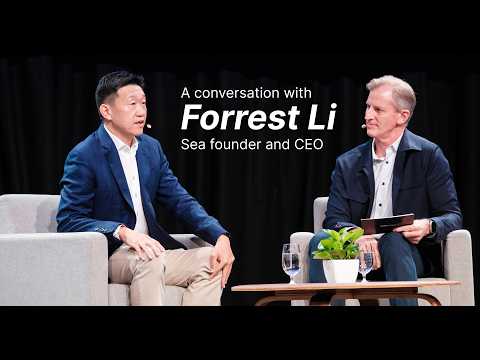
Sea founder and CEO Forrest Li in conversation with Tyler Bryson
Forrest Li argues that Sea won by solving specific local problems from the bottom up, staying humble and startup-minded, applying AI where it measurably helps, and never giving up.
Watch on YouTube ↗Charlie's summary
- ▶ 1:34
Payments, not games, were the unlock: Garena solved gamers' lack of credit cards with its own prepaid cards
Forrest saw a strong gaming culture in Southeast Asia, yet industry executives saw no business case. The gap was payments: most gamers were teenagers without credit cards. So Garena designed its own prepaid card and hand-delivered it to convenience stores and every internet cafe. Developers got revenue and gamers got the full game. Forrest says payments became the critical breakthrough.
- ▶ 5:48
Tell every hire you are joining a startup, not a big company
Forrest says Sea's expansion across games, e-commerce and finance is driven by entrepreneurial spirit. His one message to the graduating batch of its rotation program: remember you are joining a startup. He adds that entrepreneurship is not a lifestyle. You must identify the specific problem you are solving, like asking why no e-commerce marketplace existed in Southeast Asia when it worked in the US and China.
- ▶ 8:26
Outsiders fail in Southeast Asia by imposing home-market playbooks; winning needs bottom-up solutions for each market
Forrest calls the region fragmented: Singapore and Vietnam are a two-hour flight apart but very different economically. Competitors from China and the US bring proven playbooks optimized at home, which is not always the case abroad. As a Singapore company, Sea was a multinational startup from early on and knew what worked in Singapore would not work next door, so it built solutions market by market.
- ▶ 11:35
Localization means solving odd local blockers: Indonesian payments by unique prices, Brazil's logistics cost
In Indonesia, buyers could not pay online and banks hid payer identity. Shopee made each bottle of water cost a slightly different price so the price identified the buyer, and hundreds of staff did the matching. In Brazil, parcels cost over $5 to deliver, making e-commerce a wealthy person's tool. Sea's logistics experience in Southeast Asia gave it conviction to enter. Forrest says Amazon never had such problems.
Give your email to unlock the rest of the key points — for every episode.
Do more with Charlie
Free — sign in with your email, no password.