
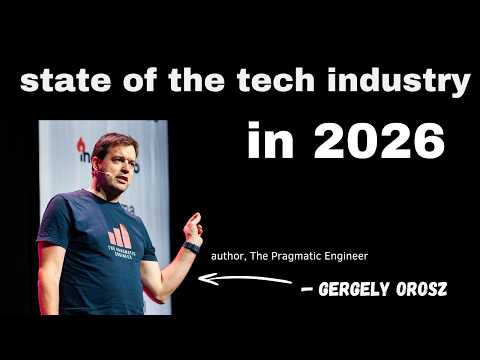
The state of the tech industry in 2026 - LDX3 New York
Gergely Orosz argues that AI agents have transformed software engineering in the last 12 months, while teams, planning and testing endure, review and reliability break, and engineering leaders must stay hands-on.
Watch on YouTube ↗Charlie's summary
- ▶ 0:30
Nobody writes code by hand anymore, and engineers now run five to ten agents in parallel
Gergely says that after January's models (Opus 4.5, GPT 5.2) paired with good harnesses, startups tracking it moved to close to 100% AI-generated code. Boris Cherny runs five terminal Claude Codes plus five to 10 on the web. Dima at Linear runs five to 10 worktrees and agents, and Peter Mattis of Cockroach Labs does the same. The one-mouse, one-keyboard, one-screen limit is gone.
- ▶ 2:38
The IDE is becoming a legacy product as everyone moves to agentic interfaces
Gergely was surprised to see heavyweight IDE usage fading. Cursor told him the IDE is now legacy: needed for enterprise, but shrinking. Cursor pivoted to an agentic interface in April, JetBrains is pivoting to Air, and OpenAI decided building Codex without an IDE was the right call. Kent Beck's view: the context for human decisions has changed.
- ▶ 4:10
If you haven't built your own coding harness, “are you even a serious tech company?”
Gergely lists Ramp, Stripe, Uber, Block, Shopify, Google, Meta and many more with internal harnesses, often built to plug in data sources they don't want to connect to Codex. Work now often starts in Slack by tagging an agent. He calls the agentic software factory real, citing OpenAI's perf factory, where agents monitor production and raise PRs, with humans reviewing critical ones.
- ▶ 6:17
Migrations that once took years now take weeks or months
Gergely cites Anthropic moving Zig to Rust with one engineer, and OpenAI moving its API from Python to Rust: about 90% done in four to five months under production load. Airbnb migrated its test library in six weeks, Asana in about two weeks, and Uber moved JUnit 4 to 5 in four months across millions of lines. All would have taken years.
Give your email to unlock the rest of the key points — for every episode.
Do more with Charlie
Free — sign in with your email, no password.