
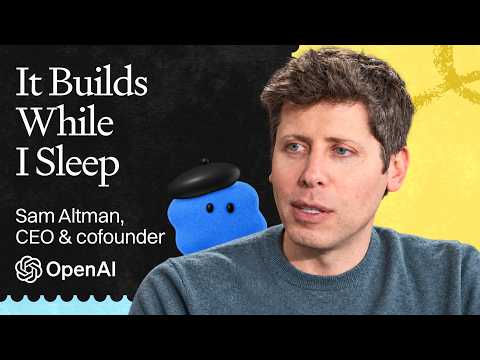
How Sam Altman Actually Uses Dots to Run OpenAI and His Life
Sam Altman argues AI will expand human demand and creativity rather than replace people, a renaissance rather than an industrial revolution, and describes how Dots, live documents and ultrafast models are changing his own work.
Watch on YouTube ↗Charlie's summary
- ▶ 0:31
People stay at the center of AI: there is huge latent demand, and we care about people, not machines
Sam was never as doomy about jobs as others, and he was still surprised by how much latent demand existed. Developers have never been able to do more, and the bar has never been higher. His explanation: we just don't care that much about what the machines do. We are obsessed with the person behind the art, company or product. Some tasks needing little creativity will go to AI, but there is no shortage of new things to do.
- ▶ 5:50
AI should be a renaissance, not an industrial revolution: centered on people, not machines
Sam sees the Renaissance as centered on people and the industrial revolution as centered on machines, which turned many people into cogs doing one specialized thing. He gets sad hearing that AI will automate everything and leave humans like house cats. He hopes for a wave of scientific discovery, art and company formation. People should share the economic gains and regain control of how they spend their time.
- ▶ 8:29
Dots gave Sam back his mornings by filtering what actually needs his attention
Sam used to check his phone first thing because overnight disasters could worsen within an hour, but that polluted the deep-work time he loved. Now he trusts his dot to use judgment about what is urgent and handle the rest. He calls it a significant improvement to his life. Examples: it warned Thibault five minutes before a demo that production would likely break it, and it flagged the one thing Sam had to attend to before a short break.
- ▶ 13:16
Agents that keep working in the background can finish what you gave up on, and turn raw voice notes into built features
Sam jots notes to his dot while on walks, and it builds five or six versions of a feature for him to give feedback on. He can leave a voice note while drifting off and wake up to the thing built plus the next seven steps. When he gave up searching Slack for something, his dot kept looking overnight and found it: a screenshot, not text. Tasks you would abandon become worth delegating.
Give your email to unlock the rest of the key points — for every episode.
Do more with Charlie
Free — sign in with your email, no password.