
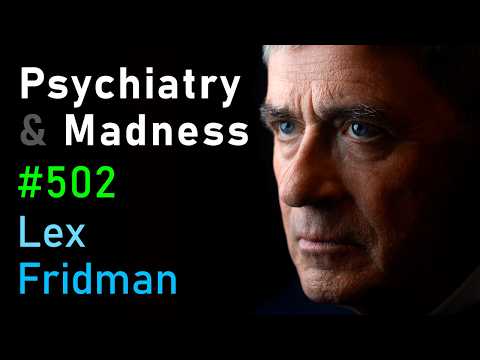
Psychiatry, Insane Asylums, Mental Illness, ECT, Lobotomies, Freud & Jung | Lex Fridman Podcast #502
Historian Andrew Scull argues psychiatry's history is a cycle of overblown cures and false confidence, leaving it with symptomatic treatments, a shaky diagnostic system, and limited progress that demands humility and broader approaches.
Watch on YouTube ↗Charlie's summary
- ▶ 6:14
Psychiatry's diagnostic system is reliable but not valid, and the $20 billion brain-disease bet has not helped patients
Andrew explains that DSM-III (1980) used symptom checklists so psychiatrists would agree with one another, which makes diagnosis reliable but not necessarily valid. Hoped-for genetic and neuroscience foundations never arrived. Thomas Insel, who led NIMH for 13 years, said that after spending 20 billion dollars the lot of the mentally ill had improved “not one bit.” Andrew sees diagnostic categories as possibly masking very different conditions.
- ▶ 38:13
Degeneration theory turned failed asylum cures into a case for sterilization and, in Germany, mass killing
Andrew says early alienists promised 70 to 80 percent cures, but asylums discharged only 35 to 40 percent, so chronic patients piled up. Psychiatrists explained the gap by blaming patients as biological degenerates. That justified lifelong confinement, then sterilization (California continued until about 1960), and in Nazi Germany the T4 program, which killed perhaps a quarter million mentally ill people. Rockefeller money had funded Ernst Rüdin's genetics work.
- ▶ 50:37
Lobotomy won a Nobel Prize after 14 years of uncontrolled experience, and Walter Freeman mechanized it
Andrew describes psychiatry's first half of the 20th century as uncontrolled experiments on patients whose voices were discounted as madness. Egas Moniz won the 1949 Nobel for lobotomy. Walter Freeman wanted to be the “Henry Ford of lobotomy,” invented the ice pick version, toured in a Lobotomobile, and did 20 or 30 in an afternoon. It faded mainly through generational change and the arrival of antipsychotic drugs.
- ▶ 1:00:50
Desperate remedies share a pattern: a plausible theory, an 80% cure claim, and no controlled trial
Andrew traces the malaria cure for syphilis (a Nobel, 1937), Henry Cotton pulling teeth, tonsils and stomachs for supposed focal sepsis (45% of abdominal surgery patients died within a year), and Sakel's insulin comas. Each claimed about 80 percent cures. Placebo effects from white coats and dramatic surgery, plus self-deception, sustained them. Insulin comas failed a controlled trial in the 1950s. Andrew now sees the same pattern when ketamine and psychedelics are hyped.
Give your email to unlock the rest of the key points — for every episode.
Do more with Charlie
Free — sign in with your email, no password.