
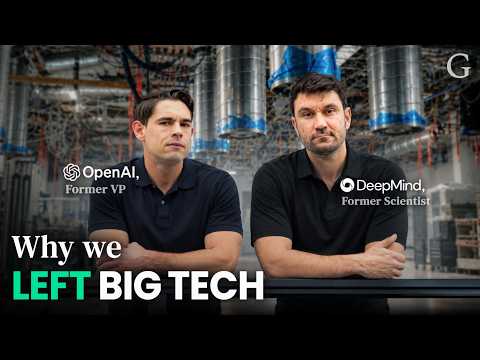
Meet the Ex-OpenAI & DeepMind Leads Creating an AI Scientist
Periodic Labs' founders argue that AI must run real experiments in the physical world, with labs, simulation and LLMs in a closed loop, to make new discoveries like high-temperature superconductors, because reading text alone cannot.
Watch on YouTube ↗Charlie's summary
- ▶ 2:06
“Thinkism is not enough”: AI must train on the scientific process, not just the literature
Liam and Doge argue that science pushes past what is already known, which clashes with machine learning's habit of testing on the same distribution it trained on. Liam doesn't think a model thinking for “a billion or a trillion tokens” will intuit a new high-temperature superconductor. Periodic instead trains end to end against the physical world, so the system learns how to do science rather than only the state of science.
- ▶ 9:59
Making a material is often harder than discovering it, so synthesis is the bottleneck
Doge says the hard part is usually making the thing you imagined, not imagining it. Atoms can't be seen or moved individually, and a lab result can take 10 to 20 years to scale up. His example is Alex Mueller, who tried nickelates, gave up and found cuprates. Forty years later nickelates turned out to be superconductors once someone learned to make them. Periodic spends much of its effort on synthesis.
- ▶ 13:40
Even simple synthesis is hard to replicate, so Periodic engineers hardware telemetry and runs replicates
Doge describes how precursor impurities and drifting furnaces undermine replication. One furnace worked for three runs and then its temperature stability went haywire. Liam says Periodic adds telemetry to expose these hidden variables and runs replicates to learn the variance. The aim is to teach the system to decide under uncertainty, such as rerunning a noisy pattern rather than overindexing on it.
- ▶ 21:37
Question everything: Liam's lesson from launching ChatGPT
Liam says ChatGPT began as a two-week sprint on GPT-3.5. Internal polls guessed 10,000 to 50,000 users, and a million was the high bar. His lesson is that people arriving later anchor on a random decision made a year earlier that was never optimal. Often it was just one IC making a call, so he urges teams to feel free to change such things.
Give your email to unlock the rest of the key points — for every episode.
Do more with Charlie
Free — sign in with your email, no password.