
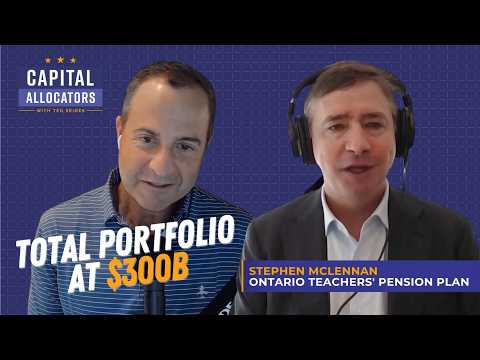
Stephen McLennan: How Ontario Teachers Exited Fixed Income and Rethought the Reference Portfolio
Stephen McLennan explains how Ontario Teachers builds a resilient, fully funded all-weather portfolio: flexible asset mix instead of a rigid reference portfolio, rigorous liquidity, humility on AI, and a dual-CIO structure.
Watch on YouTube ↗Charlie's summary
- ▶ 12:05
A reference portfolio should signal risk appetite, not dictate weights, because teams anchor to it and won't deviate when they should
Stephen says Teachers moved from a board-approved asset mix to flexible bands so management shares responsibility for the mix. His objection to rigid reference portfolios is that investment teams gravitate to their weights. With a 60/40 reference, teams resist deviating even when they know they should, as with heavy fixed income in 2020-2021. His alternative: “just tell me” the risk appetite directly, and let management deliver within guardrails.
- ▶ 20:02
Teachers cut fixed income in 2020-2022 because near-zero yields meant it could no longer act as ballast against an equity shock
Stephen describes work by the total fund management group, the CIO, CEO and board. Yields were close to zero, and they judged negative yields unlikely in North America. Expected return was low and fixed income's role as an offset to an equity shock would be harder. They reduced exposure, which Stephen calls very fortunate given what happened to bond markets afterward. The lesson is to test whether an asset still performs its role after repricing.
- ▶ 17:25
Plan on one-year and five-year horizons, and don't force allocations lower on a schedule
Stephen says five years is far enough away that nothing must be done today, but near enough that action must start now. It also matches the illiquid assets, so the fund is never a forced seller. On private equity, Teachers sees compressing prospective returns but, being fully funded, tries not to force the allocation down. It trims when pricing is attractive. Because the fund keeps growing, dollar commitments fall far less than the percentage weight.
- ▶ 25:24
Face AI uncertainty with humility and an all-weather portfolio rather than a high-conviction bet
Stephen thinks AI is changing too quickly for high-conviction views, with outcomes ranging from a productivity boom to AI tipping over. Teachers avoids over-betting on either, and keeps about 20% in an inflation-sensitive asset class (commodities including gold, private natural resources, public inflation-related products). That sleeve is meant to offset equity and bond damage in an inflation spike. He also flags US concentration as a thing to manage in passive equity.
Give your email to unlock the rest of the key points — for every episode.
Do more with Charlie
Free — sign in with your email, no password.