
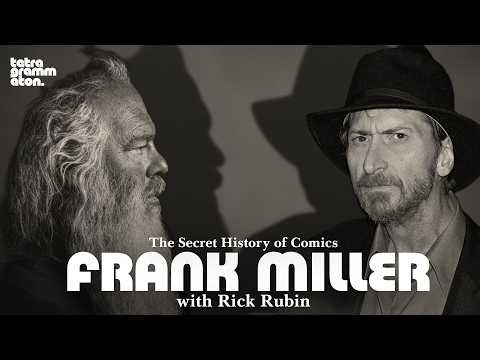
Rick Rubin Discusses The Secret History of Comics With Frank Miller
Frank Miller explains how he builds characters and stories, defends hand-drawn, boundary-pushing comics, traces the medium's history from EC to the Comics Code, and argues heroes are defined by tests, conflict and failure.
Watch on YouTube ↗Charlie's summary
- ▶ 0:03
Start from a vivid image and a mistake-friendly process: Sin City began as “Conan in a trench coat”
Frank's first Sin City note was “Conan in a trench coat”: a barbaric figure in an urban setting so it would feel nothing like a cop show. He names the brute Marv, the least tough name he could find. Scenes bolt into his head, and he often has the opening before he knows where it goes. The fun is working out what it means. He tells newcomers to “make tons of mistakes” and follow the back alleys.
- ▶ 8:08
A character is a piece of artwork, not a portrait of a person, and the best villains are perverse reflections of the hero
Frank says a heroic character carries a tone and a theme, and the world around him reflects it. The Joker works against Batman because Batman faced insanity as a child and has enforced sanity ever since, while the Joker seeks chaos. Rick's phrase, that such characters are only people “in a poetic sense”, is one Frank says he will steal. Darth Vader, the Dark Father, shows that two-dimensional can be a strength.
- ▶ 10:50
Greatness and evil coexist: there are no shades of gray, but a multiplicity of colors
Frank rejects “shades of gray” and prefers “a multiplicity of colors and complexities.” A character can have an evil streak a mile wide and still be a saint. His example is Alexander the Great, a world-changing figure who was also a ruthless slaughterer of thousands. Frank calls this dimensionality, not a contradiction: “Alexander's a nice guy would not have made the history books.”
- ▶ 11:55
Marvel's method, with artists plotting the pages and writers adding dialogue afterward, put energy on the page
Frank explains that before Marvel, comics ran in series: the writer scripted panel descriptions and dialogue, then the artist drew. Stan Lee instead handed Jack Kirby a rough story. Kirby drew the pages, added scenes and notes, and Lee scripted on top. Frank credits this for the “endless energy and vigor” of early Marvel, with characters flying across the page and talking while fighting. It helped a tiny company become a giant.
Give your email to unlock the rest of the key points — for every episode.
Do more with Charlie
Free — sign in with your email, no password.