
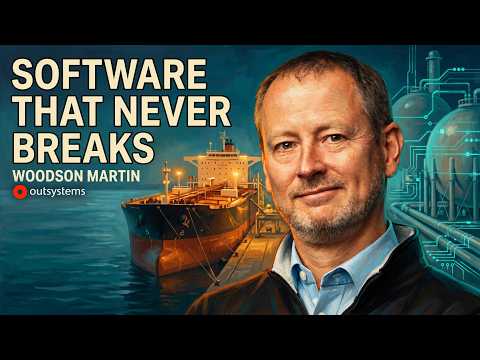
Software That Never Breaks: OutSystems CEO Woodson on Building Enterprise-Grade Apps at AI Speed
Woodson Martin argues that in the AI era, enterprises need platforms with hardened primitives, model flexibility and specialization, so software ships at AI speed without breaking and without runaway token costs.
Watch on YouTube ↗Charlie's summary
- ▶ 7:52
AI agents should manipulate an abstract model of intent, not raw code, so every generated asset inherits enterprise controls
Woodson says OutSystems puts an intermediate layer between the agent and the code. Claude Code, Codex or Mentor edit an abstract model of the application, and code is then generated deterministically. Security, role-based access and compliance are built in, and existing hardened assets are reused instead of reinvented. A bare coding agent will start everything from scratch and force another compliance cycle. Every asset inherits the enterprise control plane.
- ▶ 10:32
Enterprise trust is built over years of delivery history, which a startup cannot shortcut with cool technology
Woodson argues that for regulated enterprises, trust is not a pure technical evaluation. It is “the entire history of the delivery of systems like the one you need on that platform.” Buyers face hundreds of regulators, contractual obligations and privacy concerns. That reputation is very hard for a startup to acquire, which is why incumbents with well-developed primitives have an edge when adding an AI layer.
- ▶ 13:10
Enterprise-ready AI is mostly about compliance and governance, and agents often sit in a compliance backlog
Woodson says uptime is only part of enterprise readiness. Some customers have fully built and tested agentic systems waiting on approval of a specific model, because compliance asks whether the training data was legally acquired. Even a system that only reads PDFs into structured data can stall. Few regulated firms let autonomous agents run mission-critical work. Woodson sees this as part prudence, part legacy conservatism, and the risk tolerance differs by workflow, such as IT allocation versus auditable loan decisions.
- ▶ 23:11
A platform with shared primitives makes cyber remediation fast, because one fix lands everywhere
Woodson says speed of remediation is the first priority as cyber threats accelerate. With a concentrated portfolio on shared primitives, a vulnerability can be fixed “once in a spot” with broad impact. By contrast, hundreds of AI-built systems on their own stacks and open-source components make it hard even to find where you are exposed. He adds that there is no finish line on security, since legacy systems like 60-year-old Cobol remain.
Give your email to unlock the rest of the key points — for every episode.
Do more with Charlie
Free — sign in with your email, no password.