
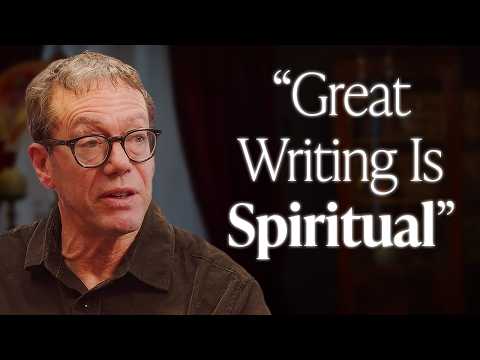
The Unwritten Laws of Great Writing (Robert Greene Interview)
Robert Greene argues that great writing needs the sublime and a living, porous spirit balanced with craft discipline, and that standardization, publishers and AI threaten both.
Watch on YouTube ↗Charlie's summary
- ▶ 3:46
If the subject isn't alive in the writer, the book will have a deadness to it
Robert thinks readers can feel an author's spirit and mood in the prose. Academic books on the sublime are so unsublime because the writer isn't feeling it. After his stroke he couldn't travel, so he worked on himself, used a different piece of music for each chapter, and tried to see the world with new eyes (a Proust idea). He wanted the book to feel alive in him first.
- ▶ 9:40
The sublime is a door out of the limiting circle your culture draws around thought
Robert defines the sublime as a point outside the circle of codes every society sets for what is real and moral. Peering through gives an electric shock that expands the mind. His book's 12 chapters are 12 such points. One is the interspecies sublime: J.A. Baker became so obsessed with a peregrine hawk that he took on its movements and tasted its kill. Robert sees this craving for transcendence as rooted in our awareness of death.
- ▶ 19:28
Defamiliarize: shift your frame of reference to see the world fresh again
Robert says we see through the framework of language and past associations, not the thing itself. Changing the angle breaks it, as when Baker realized the hawk saw him as an ugly bipedal pink creature. For Robert, Shelley, Cézanne and Van Gogh all work this way. As a writer, keep asking questions like “what is this?” and “what is money?” He applied it to the self: when did I create it? Things stop feeling familiar.
- ▶ 28:32
The daimon is your unique second self, but it must be domesticated, not left to burn you out
Robert says the daimon is who you are once social reflection is stripped away, the source of inspiration. Nietzsche found it and his books exploded out of him, but Nietzsche, Van Gogh and Rimbaud destroyed or burned out. A working writer has deadlines, so Robert says it's a balance and “a middle way”. Bring your own blood and soul into the book, or it will read like everything else. Flaubert shows both sides: method-acting Madame Bovary while obsessing over every sentence.
Give your email to unlock the rest of the key points — for every episode.
Do more with Charlie
Free — sign in with your email, no password.