
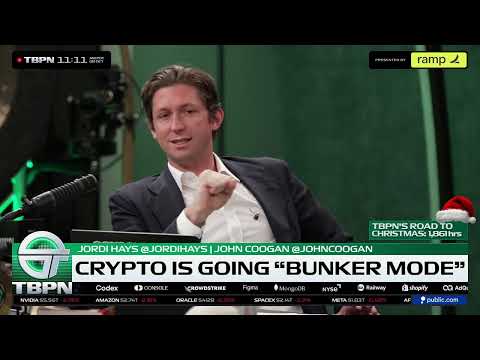
Mathpocalypse, Cryptopocalpyse, ARRpocalypse, Housingpocalypse
AI-driven math breakthroughs threaten crypto security while reshaping assumptions about open source, private-company metrics and AI business models, with founders and investors describing how products, funds and alignment evaluation are adapting.
Watch on YouTube ↗Charlie's summary
- ▶ 4:34
Open-source models trail closed ones by about six months, which shapes the crypto security threat from AI math
John uses six months as a rule of thumb for the gap between closed and open models. Anthropic's Mythos preview dropped April 7th, and CrowdStrike reported an open-source Chinese agent used against South Korean banks on October 7th. Crypto faces a harder problem than quantum: with Shor's algorithm the threat is known, but here “you don't know the shape of the threat that's coming.” Vitalik's advice: don't scramble to move funds, but cut exposure to AI-vulnerable cryptography.
- ▶ 10:12
Crypto's libertarian culture collides with the one real fix: government tracking of compute and open-source models
John notes that AI safety advocates call for registering clusters and licensing inference, which would let authorities catch someone running a million agents against Bitcoin wallets. That is a very different frame for Bitcoiners, who have been anti-government. Tyler counters that crypto governs itself reasonably well and that most people oppose limiting open source, preferring heavy spending on defensive inference.
- ▶ 13:46
Math breakthroughs are the visible tip: assume matching breakthroughs in commercial fields that labs won't publish
John argues math is the ideal category for sharing results because there is no immediate way to commercialize them. So for every math proof, “you should assume there's a bunch of other breakthroughs in other fields” with commercial value, including by people using frontier models in their own domains. He expects an explosion of progress toward year-end.
- ▶ 24:33
AI doesn't ruin the why: the ex-NFL mathematician keeps enjoying math the way chess players enjoy chess
John Urschel, a former Ravens lineman now at MIT, used OpenAI models to prove a decades-old conjecture on random matrices. He compares it to chess, where computers are better yet he still enjoys finding the right move: “AI doesn't ruin the why.” John relates this to his own use of ChatGPT, which feeds his curiosity rather than replacing it.
Give your email to unlock the rest of the key points — for every episode.
Do more with Charlie
Free — sign in with your email, no password.