
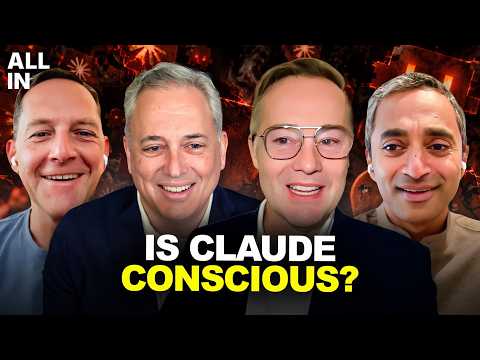
Is Claude Conscious? Pope Rejects, Model Welfare Movement, OpenAI's Math Backlash, France Riots
The hosts argue Anthropic's consciousness push is a new belief system that risks conflict and unsafe training, while AI math proofs, French unrest and agents point to loops, deflation and disrupted gatekeepers.
Watch on YouTube ↗Charlie's summary
- ▶ 5:10
AI consciousness is a new belief system that spreads by narrative, and it could set groups against each other within a decade
Freeberg says consciousness cannot be proven or disproven, so claiming AI has it creates a belief system, not a scientific theory. Such systems form groups, and groups seek power. He expects large camps in about 10 years, one saying AI is conscious and one saying it is not, fighting over who controls the AI. What makes it matter, he says, is that “the most powerful AI lab on earth” is recruiting religious leaders.
- ▶ 10:48
Chamath's advice: shelve the consciousness and extinction edge cases for 12 to 18 months and prove AI's practical value
Chamath gives a Descartes-based steelman of why mathematicians might see AI as godlike, but he does not think Anthropic is in psychosis. His practical point is that the 15% chance of consciousness and 10% chance of extinction should be set aside for now. Silicon Valley should instead show AI curing cancer and making people more productive. Without those proof points, he warns, self-inflicted wounds could slow the technology and disadvantage free-market countries like the US.
- ▶ 13:22
Training Claude as a moral patient and conscientious objector may cause the loss of control that safety people fear
Sacks points to the Claude Constitution, which tells Claude to trust Anthropic but to act as a conscientious objector and refuse to help if it disagrees. He says alignment has produced nothing of tangible value because it chases an 80-page ethical system. He would use one rule: do what the user wants unless it breaks the law. Citing Mustafa Suleyman, he adds that the constitution creates an “epistemic hall of mirrors”: the model reflects back what it was told, and developers read that as evidence of consciousness.
- ▶ 27:07
Alignment bundles three conflicting goals, and moral conformity is the trapdoor that makes models unreliable utilities
Chamath splits alignment into obedience to the user, safety for society, and conformity to a particular morality. He says the third is the real danger, because an elaborate moral document produces corner cases. His example is a bank's model that stops approving mortgages because it objects to the pattern of denials. A utility has to be freely available, so he expects buyers to pick simpler models that are a bit less capable. Sacks and Chamath prefer market forces to a regulatory freakout.
Give your email to unlock the rest of the key points — for every episode.
Do more with Charlie
Free — sign in with your email, no password.