
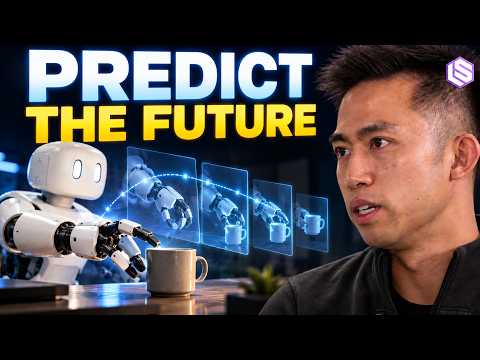
The Million-Hour Robot Brain: Dyna-2 & World Models — Jason Ma, Dyna Robotics
Jason Ma argues robotics will be solved by scaling a general world action model that predicts the future, pretrained on human video, and built full stack around real deployments.
Watch on YouTube ↗Charlie's summary
- ▶ 2:00
A world action model predicts future video and actions together, like chain of thought in physical space
Jason says Dyna-2 takes camera video, joint angles and language, then outputs actions plus future video. He compares this to chain of thought: the model reasons in visual and physics space before acting. It is a diffusion transformer, because transformers ingest the most data and diffusion refines precise, smooth motion. Dyna-2 is trained on more than a million hours of data.
- ▶ 10:42
Pretrain on human egocentric data, then adapt with a little robot data
Jason says no single data type wins. Human egocentric video is diverse and gives a strong prior on how the world evolves, but a gap remains between human and robot actions. A small amount of robot data covers low-level reflex and dexterity. He thinks data quality is non-stationary: what helps changes as the model improves. Dyna even matches robot proportions to real people so human data transfers best.
- ▶ 16:19
Synthetic environments are the next scaling frontier, now that frontier models can build them
Jason's PhD work on Eureka used GPT-4 to write simulation environments and rewards, but the model lacked vision and 3D understanding. Today's frontier models can do real-to-sim CAD and 3D reconstruction, which he sees as a tipping point. Dyna also uses its own world action model to generate training data, creating a flywheel.
- ▶ 19:21
Robot models must run on device, so train big and distill small
Jason says latency matters far more for robots than chatbots: a robot can't hold a knife idle for three seconds, and physics doesn't wait. Network calls give no guarantee, so deployed models must be small enough to serve locally. The initial model can still be large and then distilled. Dyna builds its own inference stack for this reason.
Give your email to unlock the rest of the key points — for every episode.
Do more with Charlie
Free — sign in with your email, no password.