
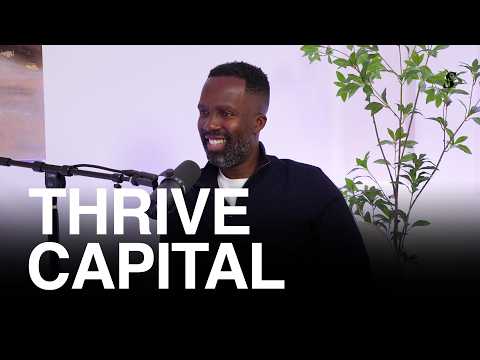
Thrive Capital’s Dr. Nworah Ayogu on Why Neuralink Is More Interesting Than SpaceX
Nworah argues that AI and new science are reshaping healthcare across the whole value chain, creating trillion-dollar companies, and that the real bottlenecks keep shifting from discovery to trials, manufacturing, delivery and payment.
Watch on YouTube ↗Charlie's summary
- ▶ 4:34
AI drug discovery's next hurdle is predicting effects, not binding molecules, and that requires generating new data
Nworah says models have gotten steadily better at designing molecules that bind a target. The harder step is predicting what happens after binding, plus the unwanted effects. Unlike code, which compiles or doesn't, this needs testing in cells, mice and people. Mouse results mislead: “we've cured cancer in mice 50 times.” So companies must generate data both to verify experiments and to train models to make those predictions.
- ▶ 9:38
Speeding up drug discovery just moves the bottleneck, so the whole chain must be fixed together
Nworah describes Isomorphic's aim of a 90% success rate and a four-year process instead of ten. That means improving molecular design, cell testing, animal testing and prediction. He says you don't want pre-clinical to get fast while clinical trials stay the bottleneck. If new drugs arrive every three years rather than ten, manufacturing must scale to absorb them too. His advice: “plan for the end at the beginning.”
- ▶ 16:14
Great hardware-biotech companies are 'bilingual', and Neurolink vertically integrates everything mission-critical
Nworah looks for companies that are world-class in both technology and science. Neurolink pairs SpaceX- and Tesla-level hardware builders with practicing neurosurgeons. It built its own implant robot for microscopic threads, and it insourced its pathology lab because safety data is critical. His rule, drawn from Elon's companies: if something is mission critical, bring it in house. He even calls Neurolink more interesting than SpaceX, since the brain underlies everything.
- ▶ 23:23
Foretell shows hardware plus AI can fix hearing loss, a top modifiable dementia risk factor
Hearing loss raises dementia likelihood by a third, Nworah says, and most hearing aids just amplify all sound, so users avoid noisy places. Foretell's founder, from Butterfly, taped out custom chips at TSMC and applied semantic noise processing, an idea he got from Zoom during the pandemic. It separates a conversation from a passing car. A third-party rater's top score was 4.5 out of 5. Foretell scored a six, so “they broke the scale.”
Give your email to unlock the rest of the key points — for every episode.
Do more with Charlie
Free — sign in with your email, no password.