
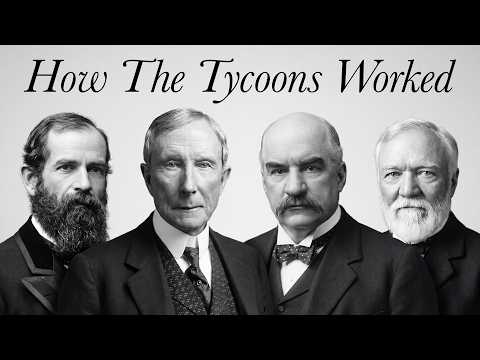
The Tycoons: Carnegie, Rockefeller, Gould & Morgan
Charles Morris's The Tycoons argues that Carnegie, Rockefeller, Gould and Morgan, through very different methods, built the infrastructure and scale on which the modern American economy rests.
Watch on YouTube ↗Charlie's summary
- ▶ 2:31
Belief comes before ability: postwar America's inventive, hungry culture was the soil these tycoons grew from.
David frames postwar America as a startup against Europe's incumbents, citing Lincoln's claim that Americans “discover and invent and improve faster than any European nation.” An English manufacturer in the book said British workmen would sabotage machines while American workmen helped invent them, and English sawyers burned new sawmills in 1825. If you have ambition, put yourself in an environment that lets you act on it.
- ▶ 7:04
Carnegie's method: focus on one objective and cut through conventions, competitors and people who block it.
As a young railroad superintendent, Carnegie burned stalled cars to clear the lines. David reads this as the classic Carnegie technique of removing the single bottleneck at any cost. Morris portrays him as ruthless and manipulative: he posed as a humanitarian while cutting pay, and he tried to cheat Henry Frick of his stake. Frick's last words to him became the title of the biography “Meet You in Hell”.
- ▶ 12:12
Rockefeller overpaid for rivals but unleashed total war on holdouts, winning through plain efficiency.
Rockefeller opened his books to targets so a sensible man would see competing was hopeless. He often paid more than a fair price. If a target refused, he attacked on price, supplies and transport until it gave in, and the offer still stood afterward. He bought for control and speed, not price, to move on to the next arena. David notes that Munger named Rockefeller the greatest entrepreneur. His former partner's refinery sold for $72,000 and the next year did $1.2 million in sales.
- ▶ 14:46
Gould's edge was finance as a weapon, and a strategy of attacking everywhere at once.
David says Gould is the tycoon he understands least. He started with nothing and mastered railroad securities when railroads were about 80% of stock market capitalization. When Vanderbilt cut cattle rates to a penny, Gould cornered the cattle market and profited from Vanderbilt's losses. Unlike most manipulators he wanted to run the railroads, and he bought up the western connections just as the Pennsylvania sold its own. Gould saw the economics of railroads before anyone else did.
Give your email to unlock the rest of the key points — for every episode.
Do more with Charlie
Free — sign in with your email, no password.