
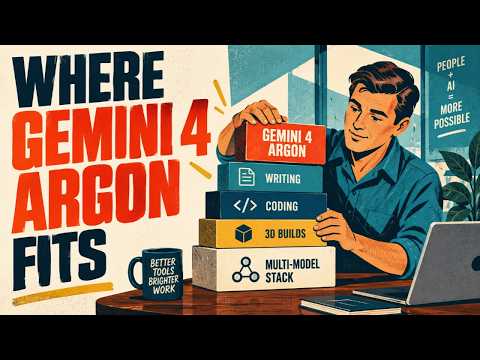
Google Is Back in the Model Race With Gemini 4 Argon
Gemini 4 Argon is a frontier-class model at a discount, weak on coding in Google's default harness but promising for multimodal work, writing and Google-ecosystem knowledge work, so the real question is where it fits.
Watch on YouTube ↗Charlie's summary
- ▶ 12:41
The right question for a new frontier model is no longer “should I switch?” but “where does it fit?”
The host argues that the question about any new frontier model has shifted. It used to be how good it is, with the implication of switching. Now it is what this model does well or differently that earns it a place in your overall model stack. He frames the whole Argon review this way.
- ▶ 13:13
By the numbers, Argon is a frontier model at a discount, strongest on knowledge work and weaker on coding.
Google's benchmarks show Argon state-of-the-art on knowledge-work tests, 13 points ahead of Fable 5.1 on Harvey's legal benchmark. On coding it trails, sitting about 10 points off the leader on Frontier Suite. Artificial Analysis scored it 53, tied for fourth. A 50% API discount runs until November 30th. After that it will be pricier than Astra but around two-thirds the price of the Anthropic models.
- ▶ 16:15
Argon's coding verdict depends on the harness: Google's own Antigravity changes the score dramatically.
Many developers found Argon poor at real code: Theo saw a greater than 50% false claim rate, and Dan Shipper's senior engineer test gave 21%. Pavel Huryn found that running it in Antigravity rather than Gemini CLI moved it from good to near Opus 5.5 Max, confirmed over three runs. But Antigravity requires the Ultra tier, and one Workspace user could not buy it without talking to sales. The host calls that friction a self-inflicted wound.
- ▶ 18:49
Argon's strength may be multimodal and from-first-principles work, though results are mixed.
Demos include AAA-looking battle chess, a pagoda complex walkthrough, and a 174,000-face Gothic carriage built from one image through code. Justine Moore's museum of Apple computers was built with no images or data supplied. But Max Techno found washed-out colors and basic scenes, and suspected training on hyped public tests. The host suggests, as with Astra, that Argon asks you to try harder, stranger things.
Give your email to unlock the rest of the key points — for every episode.
Do more with Charlie
Free — sign in with your email, no password.