
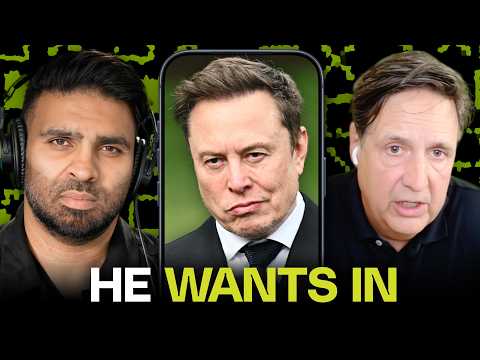
Why Elon Musk wants to sell you cell service | Decoder
Walter Piecyk argues SpaceX is serious about becoming a fourth US carrier, with a modest initial build, and that capital allocation inside Musk's empire, not feasibility, sets the pace of the threat to Verizon, AT&T and T-Mobile.
Watch on YouTube ↗Charlie's summary
- ▶ 3:02
SpaceX bought low-band spectrum because satellites alone can't do mobile; it needs a terrestrial network
Walt says phones lack the power of a rooftop dish, and the FCC approval of the EchoStar spectrum implied a terrestrial layer was required. Low-band spectrum travels further and gives better coverage, and the telcos won't offer wholesale deals. Walt thinks stocks reacted because people finally accepted that Musk will build a real terrestrial network. He also thinks Musk learns as he goes: buy, get feedback, buy more.
- ▶ 7:04
The incumbents never took Musk seriously, and could have blocked him cheaply
The 800 MHz Nextel spectrum came loose when Dish couldn't afford it. Walt argues Verizon or AT&T should have bought it and foreclosed it, even unused, since the roughly $8 billion price is less than the enterprise value they may now lose over SpaceX fears. In his view, even these companies didn't think Musk would actually build a network.
- ▶ 10:36
SpaceX can follow the T-Mobile playbook: win customers first, backfill the network later
Walt contrasts Dish, which built a network but couldn't get customers, with Musk's ability to attract them. Like John Legere's T-Mobile, SpaceX can sell on roaming and satellite coverage, then add capacity over time. Its edge: satellite coverage for suburban gaps where NIMBYism blocks towers, and room to undercut telcos running roughly 60% EBITDA margins.
- ▶ 17:11
The initial build is far cheaper than the $100–200 billion figures critics cite
Walt says those numbers reflect telcos' ongoing $10–15 billion annual spend to maintain huge customer bases. He estimates the initial build to get low-band coverage into buildings at about $10–15 billion in capex, on top of spectrum. If SpaceX wins 5–10 million customers, it can invest more, and the bull thesis is that Verizon eventually hands over a wholesale deal.
Give your email to unlock the rest of the key points — for every episode.
Do more with Charlie
Free — sign in with your email, no password.