
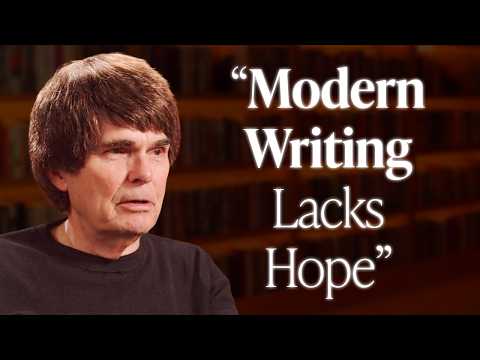
This Is What Mystical Writing Feels Like (Dean Koontz Interview)
Dean Koontz argues that great fiction comes from giving up control: let characters act freely, accept that the world is beyond comprehension, and stay open to wonder, while polishing language and character relentlessly.
Watch on YouTube ↗Charlie's summary
- ▶ 0:30
Stop outlining and give your characters free will; ending outlines turned Dean from an okay seller into a bestseller.
Dean stopped outlining partly because publishers complained that finished books weren't what they had bought, and partly because he couldn't imagine outlining a 300,000-word novel. Once he stopped, he went “from being an okay seller to a bestseller.” He says that if you stop managing characters and let them be who they are, you stay entertained yourself. If he isn't laughing or moved by the page, something has gone wrong and he backs up.
- ▶ 4:06
Accept that the world is beyond comprehension, and your characters and plots will get deeper.
After a room appeared in his unfinished house that the plans, the builder and a concrete wall said could not exist, Dean concluded the world is far stranger than we know. He notes that science keeps overturning what it thought settled. Relaxing your view of the world, he thinks, improves more than plots: you stop treating psychology “in the same old way” and handle a character's depth better. Admitting you control nothing opens the door to understanding people.
- ▶ 16:04
Reject Hemingway-style flatness: use the full toolbox of English and polish the language itself.
Dean got tired of imitators of Hemingway's minimalism producing flat prose, so he chose metaphor and simile, used cautiously. His biggest focus has been polishing language so the reader is carried along by the sentences as well as the story. He also reads poetry for pleasure: Eliot, Frost and haiku. Haiku taught him to write about death or love without naming them, which he says works on the soul, not just the mind.
- ▶ 18:08
Character is number one in fiction, and readers cry only when they see themselves in a character's suffering.
Dean says that if characters aren't well conceived and emotionally involving, “the story ain't going to work.” Suffering alone doesn't move readers. It works when they feel the character resembles them and think the same could happen to them, which is where empathy arises. John D. MacDonald taught him this: pages of character description made him want to know more about the person than the plot. Dean now aims to move readers, not just thrill them.
Give your email to unlock the rest of the key points — for every episode.
Do more with Charlie
Free — sign in with your email, no password.