
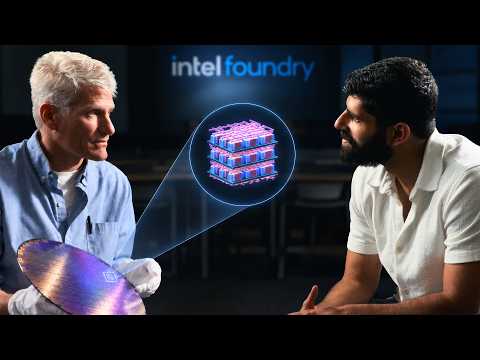
What will computer chips look like in 2045?
Intel leaders argue that making advanced chips depends on disciplined schedule-driven process development, stepwise materials and architecture innovation, and a tool supply chain that caps output growth through 2030 despite huge AI demand.
Watch on YouTube ↗Charlie's summary
- ▶ 3:42
Limit innovation per node: Intel's 10nm slip came from skipping EUV and over-aggressive scaling, so it now uses phase gates
Chris says 10nm was built on hyperscaling without new tools, because EUV was judged not ready. That put a heavy burden on engineers and delayed the node from a 2016 target to 2018. TSMC adopted EUV in 2019. Intel now uses maturity metrics in a phase gate process. A technology must hit yield, defect and performance criteria to enter development, and if it misses, it waits for the next node. Staying on schedule comes first.
- ▶ 9:39
Don't tackle a transistor change before you have to: gate-all-around was known in the '90s but waited until other levers ran out
Chris explains that gate-all-around was demonstrated in 1988 but reached production decades later. Strained silicon, high-K metal gate and FinFETs could drive performance first, so “you don't want to tackle something before you have to.” Gate-all-around also needed new materials and tools from vendors, plus iterative failed attempts. Since the 2000s, R&D has shifted from just shrinking things to changing structures and materials. Chris says materials used are up about 10X since the '90s.
- ▶ 14:25
Backside power is why High-NA EUV pays off for Intel but not for TSMC
Chris says the same tool leads to different conclusions on different architectures. Moving power lines to the back of the wafer relaxes front-side pitches, so Intel can print with a single High-NA pass. TSMC has no backside power and needs tighter pitches, so it must use double-patterned EUV and gets little help from High-NA. High-NA costs about twice as much as standard EUV, so Intel has left it as an option for 14A, decided customer by customer.
- ▶ 24:22
Never wait for a complete data set: node bring-up is about deciding how much risk to take
Kevin says you “will never have a complete data set,” and waiting for one means you've “waited too long.” In Hot Topics meetings he decides whether to go now and risk production. For problems like epi nodules, teams work highly parallel on every potential fix, since the obvious one is not always the one that works. The highest-priority wafers get HotBox 1, which races through the factory but drags overall efficiency, like a carpool lane.
Give your email to unlock the rest of the key points — for every episode.
Do more with Charlie
Free — sign in with your email, no password.