
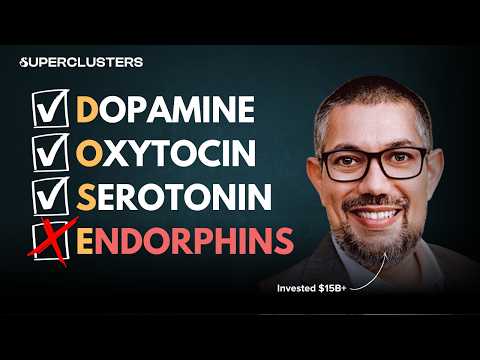
You're missing endorphins in your pitch deck! | El Pack w/ Asher Siddiqui
Asher Siddiqui argues that LPs underwrite people rather than theses or logos, so emerging managers should lead with their lived story and motivation, and that venture is a purist, individual-driven game.
Watch on YouTube ↗Charlie's summary
- ▶ 2:05
LPs decide through DOSE: dopamine, oxytocin, serotonin, endorphins, so a pitch must deliver all four
Asher thinks decisions run on a neurochemical cocktail. Dopamine is excitement, oxytocin is social trust, serotonin is confidence in competence, and endorphins are relief from stress. A deck with track record but no excitement leaves him with “all the information” and no decision. A deck with excitement but no clear process leaves him stressed. Build a pitch that modulates all four.
- ▶ 9:50
Logos and pedigree matter less than intrinsic motivation, so GPs should tell their lived story
Asher finds repeated logo-dropping boring: mentioning a logo once is enough, and more starts to suggest “that's all there is to it.” He wants to know why a GP is doing something painful and low-paying for 10 to 20 years, and what insight is obvious to them but not to others. As a GP he spent first founder meetings asking about parents and upbringing, and only later asked about the product.
- ▶ 18:00
Underwrite the person, and pitch like a first date: reveal your thesis in stages
Asher says venture has no point of perfect information, so LPs are underwriting a person, and most decisions come down to chemistry and trust. With limited time, he suggests treating a pitch as a first date. Tell his wife on date one that he wanted five children and he would be single. Share the one thing closest to your core, win the second meeting, and reveal more over several meetings. He sees backing emerging managers as like backing pre-seed founders.
- ▶ 33:32
Venture is still venture; Asher doesn't think capital flowing to later stages means 2 and 20 is broken
Asked whether venture has split into discovery and validation capital, Asher calls himself a purist and sees early-stage venture as unchanged, with later stages as other stages of innovation capital. He thinks the 2 and 20 model still works. He is not bothered that most capital goes late, since there is more early-stage capital in absolute terms than 5, 10 or 20 years ago.
Give your email to unlock the rest of the key points — for every episode.
Do more with Charlie
Free — sign in with your email, no password.