
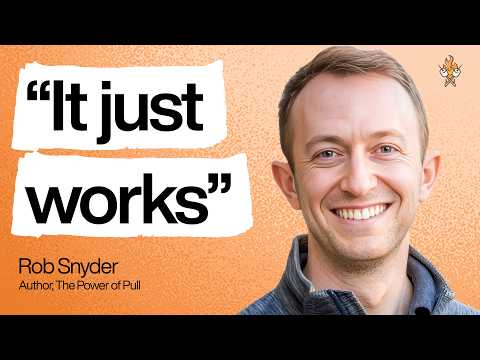
An 86-minute guide to finding PMF | Rob Snyder (Author, The Power of Pull)
Rob Snyder argues product-market fit is found, not manufactured: look for a specific person with an urgent, blocked project who would be weird not to buy, then test that hypothesis through direct sales conversations.
Watch on YouTube ↗Charlie's summary
- ▶ 4:04
Pull comes from priorities, not pain points: someone with an urgent project their existing options can't solve will rip your product out of your hands
Rob spent two years selling a product with hair-on-fire pain points and design partners, and got nowhere. He concluded that people can agree your product has value and still not drop their priorities to buy it. Pull exists when someone is a coiled spring with a project they can't finish with current tools. You don't convince people to have pull. You find it.
- ▶ 7:37
The PULL acronym: Project, Unavoidable, List of options, Limitations — you need all four at once
Rob's framework asks for a project on the to-do list, a reason it must happen now, the options considered, and why they fall short. Jump, an AI notetaker for financial advisors, had all four: advisors must log notes in a CRM or risk jail, and generic notetakers lacked CRM integration and SEC compliance. Insurance agents lacked the unavoidable piece, so no pull. Missing one element means people complain but don't buy.
- ▶ 16:21
Pull belongs to a person, not a company
Rob says a common mistake is treating pull as something a company has. You aren't selling to SpaceX, you're selling to the head of legal there who has a specific project she can't do herself. We sell to mid-market private equity is too vague. Name the operating partner trying to do X, Y and Z, and build your hypothesis around that individual.
- ▶ 18:58
Find ideas by doing the job firsthand, then write a pull hypothesis and test it
Rob says ideas don't emerge from whiteboards or brainstorms. A friend shadowed several industries, hated the solar installers, loved independent physical therapists, spent days at their shoulders, and spotted a cost they were stuck on. He wrote a pull hypothesis, asked a therapist “is this you?”, then confirmed it repeated with five more. Rob puts roughly 90% of his clients' ideas down to firsthand experience.
Give your email to unlock the rest of the key points — for every episode.
Do more with Charlie
Free — sign in with your email, no password.