
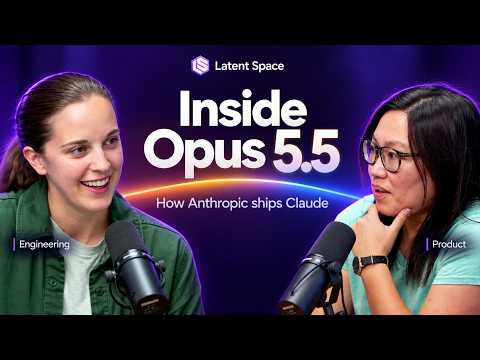
How Anthropic ships the #1 LLM in the World — with Katelyn Lesse and Angela Jiang
Anthropic's platform leaders explain how they ship models and the API safely and at scale: anti-distillation tradeoffs, generic trust primitives, a Rust port, secure agent architecture, and evals-as-research.
Watch on YouTube ↗Charlie's summary
- ▶ 19:30
Model launches are now mostly safety, distillation and policy work, not just shipping a better model
Katelyn says the majority of launch work is now distillation prevention, online and offline safeguards, and per-model policy decisions such as data retention. Opus 5.5 launched without the retention requirements Fable has, so each launch needs its own policy call and enforcement. Angela adds that scrutiny scales with capability, especially where it is dual use, like cyber and bio.
- ▶ 9:46
Distillation is a safety problem for Anthropic, not a commercial one
Angela says people frame distillation as commercial, but “if you distill from us, we actually pay us.” The real worry is distilled models running without safeguard classifiers. Chain-of-thought extraction is the most powerful method, so they enforced preserved thinking blocks. Katelyn says they avoided a yolo rollout, working with open-source harness maintainers and shipping a compaction feature so customers weren't broken.
- ▶ 24:32
Build generic trust primitives as hedges: product planning is now a probabilistic portfolio of bets
After Fable was pulled back, the team built an authorization layer that could act as a single pull-back button. Angela says product management has become deeply probabilistic: hedge against unlikely events. They chose a generic design for the access program and trust grants, which later paid off for model access, grandfathering and deployments.
- ▶ 31:07
Model feedback is vibes plus evals, and the hardest tradeoff is laziness versus proactivity
Anthropic gives early access to customers like Cognition and Cursor-style harness builders who run full eval suites. Katelyn says negative feedback is most useful, and API customers catch what internal dogfooding misses. People want different behavior, so one early Opus version was put back in the oven to train out laziness. Personalization is handled with parameters like effort, not solved.
Give your email to unlock the rest of the key points — for every episode.
Do more with Charlie
Free — sign in with your email, no password.