
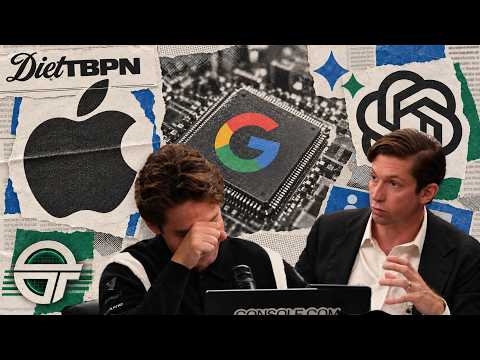
Apple’s ‘Pro and Tell,’ Google’s Two New AI Models, OpenAI Eyes Google’s Custom Chips | Diet TBPN
Apple's touchscreen MacBook Pro event, Google's Genie 4 and Gemini 4 Carbon launches, OpenAI buying Google TPUs, and Instinct's $30B raise all point to a market where every lab uses every chip and growth outruns skepticism.
Watch on YouTube ↗Charlie's summary
- ▶ 4:03
Apple brought back the lighting Apple logo because a $2 part is trivial against a $4,000 price
John says the lit-up Apple logo on the back of the screen drew the biggest applause at the event, bigger than touch. His theory: it costs about $2 per unit. That was noticeable on a $1,000 laptop, but memory and chip prices now push typical configurations to around $4,000. Apple also left prices off the keynote slides because of the component crunch. The 14-inch starts around $2,900 and the 16-inch around $3,400.
- ▶ 8:08
World models like Genie 4 could make real-time virtual backdrops and set extensions for creators
Google's Genie 4 is a research preview that lets users steer environments in real time, with native audio and physics. John sees the near-term use as content creation, not research. If quality holds, a camera could track your position while the model generates the world around you. He describes filming someone on a virtual beach, walking outside, and having it imagine the boardwalk next. Gaming is another possible use.
- ▶ 10:12
Gemini 4 Carbon tops the benchmarks, but Google has a history of benchmark wins that feel weaker in use
Google says Carbon ranks first on the Artificial Analysis index at 59 and scored 88.2% on SEC bench pro. The hosts note a year of launches that looked great on benchmarks but felt less impressive in real use. Jordy points out that the naming runs opposite to Anthropic's: Carbon is atomic number 6 and Argon is 18. John hopes version numbers fade out and labs settle on legible names for big and small models.
- ▶ 15:55
Every lab will use every chip, so OpenAI buying Google TPUs is business over rivalry
OpenAI plans to buy Google's chips, a year after it was founded partly in opposition to Google. John argues that labs are using every chip, data center and neocloud, and that different chips suit different parts of the inference stack. Agents make porting easy, and he cites Anthropic vibe coding its AMD implementation. This favors anyone who bet on a non-Nvidia market, though Nvidia dependence remains high. Dylan Patel's data shows huge leases, including OpenAI's 8 gigawatt commitment in Ohio.
Give your email to unlock the rest of the key points — for every episode.
Do more with Charlie
Free — sign in with your email, no password.