
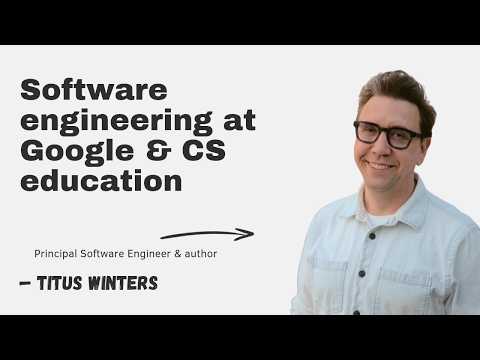
Software engineering at Google & CS education with Titus Winters
Titus Winters argues that Google's engineering lessons—tests, safe change, deterministic tooling, psychological safety—still hold in the AI era, and that CS education must shift from writing code to specification, testing and teamwork.
Watch on YouTube ↗Charlie's summary
- ▶ 14:46
Fear of making changes is not an acceptable basis for engineering; a sustainable code base lets you make any valuable change safely
Titus says Google's testing culture began around 2006, when search could no longer ship on a regular cadence. Release engineers refused any merge without tests, whatever a VP said. Titus believes a code base is sustainable if you can make any valuable change safely, even if you choose not to. With security getting “real real bad,” the ability to change is a strategic advantage. If you are afraid to push code, either the system or the onboarding is broken.
- ▶ 26:05
Refactor huge code bases with deterministic, compiler-assisted tools, and use AI to write those tools
Titus's Abseil cleanup of roughly 250 million lines of C++ used map-reduce over parse trees to match exact code patterns and generate edits. Old and new APIs coexisted, edits were parallelized by directory, then the old one was deleted. He says AI is very good at generating OpenRewrite recipes, which are cheaper, more accurate and auditable. Titus agrees with the view “don't use AI for constant inference”; use it to build deterministic tools. The same logic applies to turning AI code-review findings into lint rules.
- ▶ 42:59
Google's readability review worked as a mentoring program that turned code review into education at massive scale
Readability required a change to be approved by someone certified in idiomatic code for that language. It began with an early employee walking every newcomer through a first change, then became a round-robin mentoring pool after a team had signed off. Teams with strong standards graduate quickly. Titus, who owned the program when he left, thinks it may be the largest educational program in tech, with tens of thousands of participants at any moment. He also describes it as a quiet information-sharing channel across the code base.
- ▶ 48:34
Software engineering is a team sport, and its best predictor is psychological safety and learning culture
Titus says that even if engineers manage teams of agents, team behavior still matters, and most engineers lack training to manage agents. He cites DORA research: about 30% of the variance in whether teams hit their goals can be predicted from culture questions. Work is an iterated game, so you should give juniors stretch tasks with supervision. That only works if people can admit they don't know something. AI labs get this naturally because everyone is learning and growing fast.
Give your email to unlock the rest of the key points — for every episode.
Do more with Charlie
Free — sign in with your email, no password.