
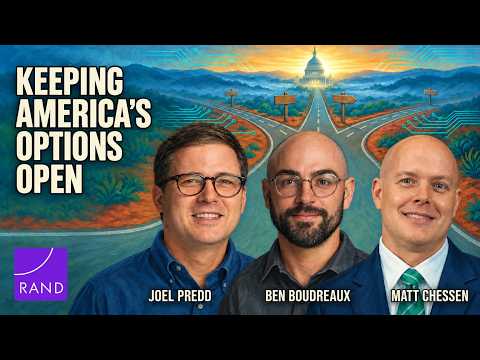
Freedom of Action: America's ASI Strategy, w/ RAND's Joel Predd, Ben Boudreaux & Matt Chessen
RAND researchers argue the US should not commit to any one superintelligence strategy yet, and should instead build the capabilities that keep every option open until key uncertainties resolve.
Watch on YouTube ↗Charlie's summary
- ▶ 12:48
Don't pre-commit: with no consensus on five pivot questions, the US should maintain freedom of action across seven archetypal strategies
Matt says the seven archetypes are dominance, co-development, preparedness, moratorium, deterrence, continuity of society and acceleration. Five questions sort them: is danger close, is coexistence feasible, is restraint feasible, is a decisive advantage reachable, is suppression feasible. Each strategy has a pathology, such as dominance risking power concentration. Picking wrong forecloses options and destroys trust. The US has no declared strategy and may be accelerating by default.
- ▶ 26:05
The pivot factors are partly endogenous: the US can act to push danger further off or make restraint more feasible
Ben stresses that the pivots are not simply things happening to us. Choices can push danger further off, make restraint more feasible, or build diffusion capabilities that enable a lead. The aim is to use agency now to preserve it later. Ben sees decision-makers starting to recognize that AI development and diffusion can be shaped, for instance through discussions of pacing.
- ▶ 31:41
A decisive strategic advantage is hard to define, and Joel says it might come through a 'wonder weapon'
Joel says the advantage could be technological, economic or military, and each needs different things. Preventing rivals from crossing a threshold looks harder than keeping a steady lead. Game theory work by a colleague suggests competition drifts toward mutual sabotage, unless AI yields a 'wonder weapon' that holds rivals' programs at risk. Joel cites Mythos-class cyber capabilities as a possible first example. Ben adds that a fast takeoff may leave too little time to build control.
- ▶ 46:58
Perceptions of the pivot factors drive outcomes more than facts do, because no science exists to settle them
Joel says that in hundreds of RAND tabletop games, players' prior beliefs about the pivots, such as whether a decisive advantage is real or danger is close, largely determine how games end. The Los Alamos scientists could run a calculation before the Trinity test. Nothing comparable exists for whether danger is close, coexistence is possible or a decisive advantage is real, so beliefs dominate.
Give your email to unlock the rest of the key points — for every episode.
Do more with Charlie
Free — sign in with your email, no password.