
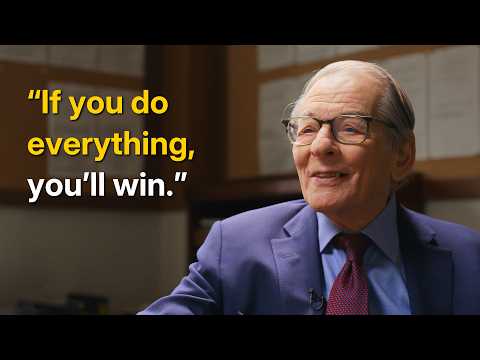
What Robert Caro learned about power after studying it for 50 years
Robert Caro argues that political genius is the will to get big things done despite obstacles, that power hardens and corrupts its holders, and that his own method relies on relentlessness and focus.
Watch on YouTube ↗Charlie's summary
- ▶ 2:37
Don't take no for an answer: Caro interviews the one person who knows, because the best stories come when you ask why
Caro says some people must be interviewed, and a refusal can't end it. Lyndon Johnson's first secretary was the only person who knew what Johnson did on those long drives across Texas. John Connally, who handed out Johnson's money, explained that No, never meant the man would never get money from Johnson. Asking why Johnson felt that way about a congressman is “when the really fascinating stories emerge.”
- ▶ 5:54
Building has always looked impossible; political genius periodically appears and gets big things built anyway
Asked whether safeguards now make building too hard, Caro answers that in the 1920s people were also saying government can't build anything. Robert Moses had no eminent domain power, yet he got a road through scores of unwilling properties to reach Jones Beach. Caro says decades may pass with no such figure, then one appears. He doesn't want someone as ruthless as Moses, but a way to get things built has to be found.
- ▶ 12:56
Moses went from idealist to a man who builds for its own sake, and he never saw himself change
Caro says the early Moses fought for civil service reform and beaches for city people. Over time he came to want roads built no matter who was in the way. The Cross Bronx Expressway evicted tens of thousands without relocation, and it became “the world's longest traffic jam.” Moses learned to exploit people's weaknesses, as with Henry Epstein. The question Caro would ask in an eighth interview: “Did you realize you were changing?” He thinks Moses never did.
- ▶ 21:35
Moses's power rested on popularity and an interlocking web of posts, so firing him took cracks in the armor
Caro says earlier mayors and governors couldn't call his resignation bluff. Moses was the idol of New York, and he held so many posts with different terms that he couldn't be removed from everything. Rockefeller could accept the resignation in 1962 only after cracks had appeared. Caro also remembers a last interview in which the secretary had no calls to report: power gone, and Moses insulated from the fact.
Give your email to unlock the rest of the key points — for every episode.
Do more with Charlie
Free — sign in with your email, no password.