
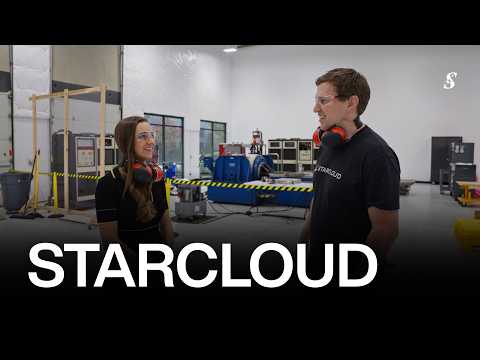
Nvidia GPUs in Orbit: Inside Starcloud’s $2B Factory
Philip Johnston argues orbital data centers beat terrestrial ones once launch costs fall to about $500 a kilo, and describes how Starcloud's lean, scrappy, vertically integrated team is building toward that.
Watch on YouTube ↗Charlie's summary
- ▶ 2:59
Scrappy hardware speed: Starcloud went from founding to orbit in 21 months and built Starcloud 1 for about $2.5 million
Philip says the fastest prior company took four years, and a prime quoted $75 million to $100 million for Starcloud 1, which Starcloud did for about $2.5 million. The team bought a broken secondhand vibration table for $200,000 instead of waiting nearly two years and paying about $1.5 million for a new one, then repaired it over a weekend. Philip calls being scrappy the startup's superpower.
- ▶ 7:03
Seattle is the best place to build space data centers because it has both satellite and hyperscaler talent
Philip says 90% of satellites launched in recent years by mass were designed, built and tested in Redmond, Washington. He and Ezra started searching in LinkedIn from El Segundo, and results kept pointing to Redmond. About half the team came from SpaceX and the other half from hyperscalers such as AWS and Azure, which sit nearby.
- ▶ 32:07
Space data centers win on economics once launch costs fall below about $500 a kilo
Philip compares space with terrestrial solar. In orbit there is no permitted land (the biggest cost on Earth), no batteries or backup power because the sun shines constantly, and eight times fewer solar cells are needed. The remaining cost is launch. Falcon 9 is about $5,000 a kilo, while Starship is designed for internal costs of $20 to $40 a kilo. Philip expects SpaceX to sell commercial capacity from 2028.
- ▶ 34:10
Chip failure rates, not cooling, are the real risk, so Starcloud burns chips in and tests them in particle accelerators
Philip says cooling is basically solved, but a 10 to 20% higher chip failure rate in space would break the economics, since chips are the most expensive part. Starcloud can't service satellites after launch, so it adds redundancy, overprovisions solar panels, and runs a three-month burn-in to pass infant mortality failures. It also tests chips in particle accelerators and works on radiation shielding.
Give your email to unlock the rest of the key points — for every episode.
Do more with Charlie
Free — sign in with your email, no password.