
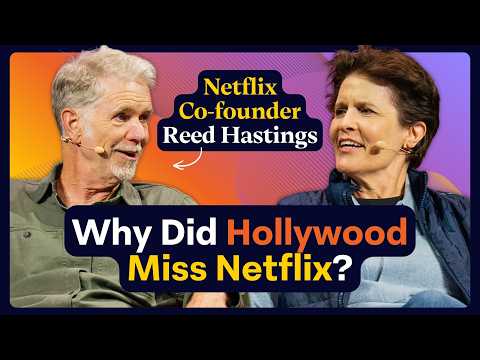
Reed Hastings & Kara Swisher on Netflix’s rise and AI’s next wave | Masters of Scale Summit 2026
Reed Hastings argues that founders should bet on exponential change, accept radical mistakes, guard against over-learned lessons, and expect AI to disrupt incumbents and education while safety and regulation lag.
Watch on YouTube ↗Charlie's summary
- ▶ 6:40
When things change constantly, you bet forward, and exponential technologies are what most people underestimate
Reed says he, Chad Hurley and Jason Kilar had all grown up on the internet, so betting on streaming felt natural when it took imagination. Most industries, like cars, improve slowly. Only Moore's law and its relatives, now AI, give exponential effects that are so unfamiliar that many people underestimate where things will be in two or three years.
- ▶ 8:13
Being radical means getting some things wrong: the Quickster incident
Netflix made many radical decisions that proved right and one that proved wrong: splitting DVD and streaming too soon in 2011, the Quickster incident. Reed says Netflix didn't grandfather the pricing, so it was an effective price increase. Still, he thinks the only way to grow DVD, convert to streaming, go global and make original content was to be pretty radical, which means accepting some misses.
- ▶ 10:16
The biggest miss was original content, and Netflix needed Ted Sarandos to convince Reed to swing for home runs
Reed thought original content was a way to lose money, like Walmart going into music, after an early attempt got crushed without a scale distribution platform. Ted argued Netflix could follow HBO, which started on others' content and then made its own. Reed gave him license to swing, and Orange is the New Black and House of Cards followed. Reed says that if those first two had failed, Netflix probably wouldn't be in content.
- ▶ 13:21
Over-learning a lesson creates a blind spot, as Jeff Bewkes showed with the internet
Reed argues that Jeff Bewkes, who warned against the 2001 AOL-Warner merger and helped save the company, took away that the internet is bunk. That made him a hero, but by 2009 he believed the internet would never do entertainment. In Reed's words, “he overlearned the thing that made him great.” The lesson is to hold your own formative lessons loosely.
Give your email to unlock the rest of the key points — for every episode.
Do more with Charlie
Free — sign in with your email, no password.