
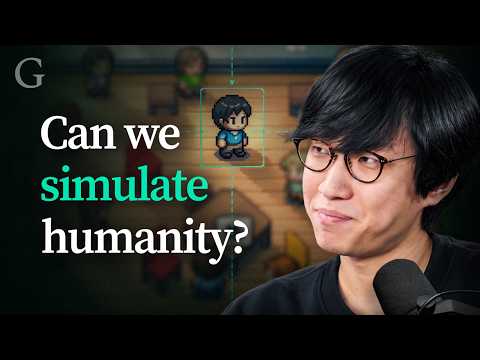
Every Human Is About to Get an AI Twin | Joon Sung Park
Joon Sung Park argues that generative-AI simulations of real people, built from interviews and behavioral data, can predict behavior and let organizations test decisions and explore wicked societal problems before acting.
Watch on YouTube ↗Charlie's summary
- ▶ 4:32
Schelling's checkerboard shows emergence, and generative AI can revive agent-based simulation at far higher fidelity
Joon cites Thomas Schelling's 1970s segregation model: red and blue dots with one mild same-color preference still produced fully segregated societies, with no overt racism in any individual. Those agents were simple and deterministic. Joon thinks generative models, which encode human behavior, can put agents in realistic environments. The ambition is wicked problems like climate change or democratic collapse.
- ▶ 10:41
The arc of simulation runs from asking questions to giving the simulator a goal, as in Asimov's Foundation
Joon sees simulation moving from answering questions to receiving an end state. In Foundation, scientists ask how to cut unrest from 20,000 years to 1,000 and the simulator proposes counterintuitive first steps, such as exiling the scientist who predicted collapse. Simulation explores a multiverse of possibilities and the causal mechanisms behind them. He also expects institutions to want specialized simulators as a competitive advantage.
- ▶ 23:29
Simulation, like portraiture, is judged by what it reveals, and humans supply the framing and emotional rigor
Trained as a painter, Joon says the best portraits say something hidden about the subject, and simulation should do the same. Artists decide what is worth caring about, and Joon argues the same holds for simulation: AI can simulate anyone, but humans decide who to simulate, which phenomena to explore, and which solutions to consider. He adds that portraits tend to resemble the painter, and the simulations are more collective because real, consenting people inform them.
- ▶ 27:31
Simulation as a service: real interviews build a model customers can query endlessly, in four stages
Simile talks to tens or hundreds of thousands of real people weekly, through partners like Gallup with access to 30 to 40 million. It asks broad questions such as “tell me the story of your life” rather than narrow research ones. Customers filter a population and pose a survey, product or policy. Joon's four stages: static individuals, dynamic individual agents, multi-agent, and societal simulation. Customers today have the first three.
Give your email to unlock the rest of the key points — for every episode.
Do more with Charlie
Free — sign in with your email, no password.