
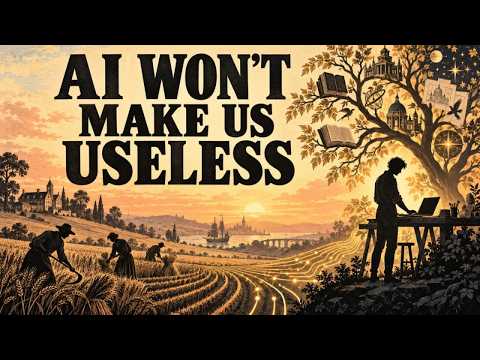
AI Won’t Make Our Minds Useless According to 400 Years of History
Venkatesh Rao's 'cognitive mercantilism' essay argues AI panic mirrors pre-capitalist scarcity thinking, and that abundant intelligence, like abundant food, will expand demand and free minds rather than make them useless.
Watch on YouTube ↗Charlie's summary
- ▶ 1:31
AI panic is 'cognitive mercantilism': treating intelligence as a fixed, scarce resource, just as mercantilists treated wealth
Drawing on Joyce Appleby's history of capitalism, the essay maps four mercantilist beliefs onto intelligence. Intelligence is finite and hoarded like bullion. The masses can't be trusted with it. Supply is the central fact. Most people are good for little intellectually. NLW found the parallels “almost embarrassingly direct.” The reframe: the fear of AI is old scarcity thinking applied to minds.
- ▶ 6:04
Like farming, producing intelligence may stop being necessary for most people, who become consumers of it instead
Farming once occupied about 80% of people, and its mechanization didn't create useless mouths; it freed people to do other things while eating far better. The essay's author can't farm, yet enjoys astonishing food. The analogy: most people may no longer need to produce intelligence to consume it, enjoy it and build on it, so inability to produce it becomes economically almost irrelevant.
- ▶ 7:05
The lump-of-labor fallacy hides an assumption that demand has no elasticity; NLW sees six kinds of unlockable demand
NLW argues that fears of job loss assume we already demand as much as we ever could, which he calls crazy and ahistorical. He lists six elasticities AI could unlock: price, access, complexity, continuity, personalization and relational. Each is a way a previously unmet want becomes servable, so more demand appears. Our capacity to demand is, in his view, nearly limitless.
- ▶ 8:36
New desires drove voluntary work: early consumer goods raised working days from about 250 to 300 a year
Appleby's account says tobacco, tea, sugar and colorful Indian cotton created new wants among ordinary Britons before factories arrived. People voluntarily worked more days and adopted productive practices, creating a virtuous cycle of surplus income and demand. Labor politics became partly about securing a fair share of expanding consumption, not only escaping coercion. That is a richer model for AI than simple job replacement.
Give your email to unlock the rest of the key points — for every episode.
Do more with Charlie
Free — sign in with your email, no password.