
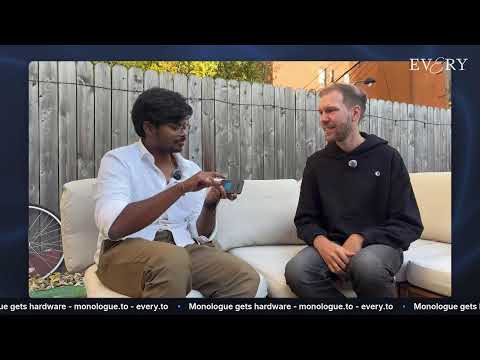
Every Think Week: Monologue HARDWARE?!
Naveen shows an early, 3D-printed Monologue hardware prototype built in two weeks with AI help, arguing hardware iteration now resembles software and that dictation plus notes for agents is worth exploring.
Watch on YouTube ↗Charlie's summary
- ▶ 2:04
Monologue's first hardware is a credit-card-sized dictation and notes device, built because why not it should exist
Naveen's bar is first whether he uses it himself, then whether people at Every do. The card pairs by Bluetooth, has a big blue dictate button, and has a much better microphone than a phone. He admits “we are not special yet” versus competitors. His reason to build is that it should exist, and a team of two did it.
- ▶ 8:15
One device combines dictation and always-available notes, fixing the phone's microphone-session hassle
The big button dictates into iPhone or Mac without leaving the keyboard to open the Monologue app, which the phone requires because of microphone sessions. A second white button starts note recording, picking up other people's voices. It has onboard memory for about three hours of audio, with a goal of days. Naveen is unsure whether two buttons or one is right.
- ▶ 11:49
Hardware should give feedback and talk to agents: screen, vibration, and triggers beyond a single button
Naveen wants a screen showing recording status and time, because with Limitless you may record for two hours and find the battery dead. The device also vibrates. Naveen sees it as an interface to agents: brain-dump into the Monologue feed, have agents act on it, and buzz when an agent needs input. His cohost suggests trigger gestures and webhooks, and Naveen hopes for a touch surface.
- ▶ 19:31
Hardware iteration collapsed from four weeks to two: AI-assisted, vibe-coded hardware design
Naveen, who has an electrical background, says prototypes used to take about four weeks of PCB printing, shipping, and testing. This one took two weeks, from early October to month's end, with a teammate making a custom PCB at home and a Claude-assisted workflow. It uses an off-the-shelf ESP C6 microcontroller. Naveen thinks “doing hardware is same as software” and expects a richer ecosystem within a year.
Give your email to unlock the rest of the key points — for every episode.
Do more with Charlie
Free — sign in with your email, no password.