
AI Lurches Towards RSI
As AI nears recursive self-improvement, NLW argues that Musk's cost admission, the MIT weight-editing result, and Anthropic's S-1 update each raise real questions, but model gains may not translate straight into adoption and revenue.
Watch on YouTube ↗Charlie's summary
- ▶ 2:32
Grokbot's usage cuts reignited the debate over whether personal agents can ever pay for themselves
Musk said Grokbot's serving cost was “unsustainably high relative to revenue” after users hit new usage limits. Bears took it as proof the bubble is bursting, and critics compared it to a 12-inch pizza quietly shrunk to 6. Dax of Open Code argued people won't pay for this product shape, so it must be a top-of-funnel product. NLW notes that this free-user cost debate dates back to the fall 2025 bubble arguments, and it remains open.
- ▶ 9:35
The end of the AI subsidy era won't change much: users will split into two camps
NLW thinks moving to true API pricing sorts users into two groups. One group is satisfied with efficient models on $20 or $30 plans. The other gets enough value to pay for the intelligence they consume as a cost of doing business. NLW runs APIs everywhere at a cost far below human labor, so for him it is “net new money.” He sees the bear case as contradictory: either users leave when they pay, or revenue is concentrated in a few power users. He welcomes the bears, since a loud bear case lowers bubble odds.
- ▶ 15:43
Cheaper models and everyday-task benchmarks may make personal agents cost-effective
On SemiAnalysis's GDPX benchmark, Opus 55 scored 12% at $51 per task, while Gemini 4 scored 10.9% at $16, about 4x cheaper. OpenAI's LifeVal measures everyday tasks and shows GPT6 Astra rising from 49.3% to 80.6%. NLW notes that once a capability is measured and becomes an RL target, it improves quickly and gets cheaper, as happened with coding. Meanwhile Meta's Muse could use its 500 million SMB marketers as distribution.
- ▶ 18:14
An MIT paper shows a large model can edit a small model's weights directly, like gene editing for neural networks
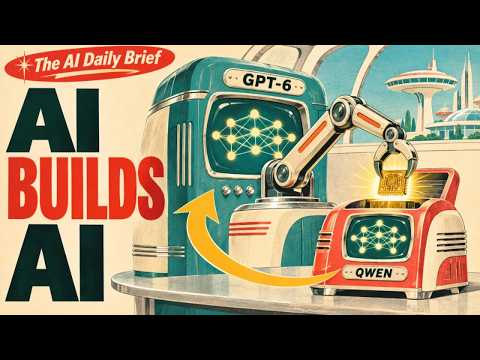
GPT6 Astra was asked to make Qwen 3.5 0.8B better at math. With 50 forward passes and no gradients or training, it found reasoning loops and edited out the cause, changing 0.016% of weights. Math scores rose 6x and instruction following 3x. Astra also wrote small gameplay networks from scratch that beat PPO-trained ones. Google researcher Alex Kranel replicated it, but stressed that the models are tiny and the capability is closer to scaled-up interpretability.
Give your email to unlock the rest of the key points — for every episode.
Do more with Charlie
Free — sign in with your email, no password.