
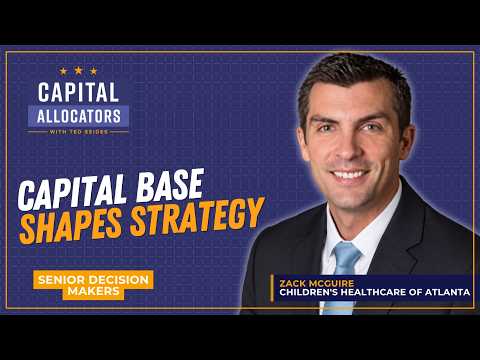
Zack McGuire: Dynamic Allocation and Concentrated Conviction at Children's Healthcare of Atlanta
Zack McGuire explains how Children's Healthcare of Atlanta builds its portfolio from the nature of its capital base, using dynamic allocation, team-based decisions, mission-driven access and system integration.
Watch on YouTube ↗Charlie's summary
- ▶ 15:50
Start with the nature of the capital base, not asset allocation or manager selection
Zack says the same asset classes serve different objectives at a pension, hospital system and endowment. He starts with liabilities, dependence on the portfolio, time horizon, governance, and an institution's ability and willingness to take risk, which “are not the same thing.” Philosophy comes from that, then strategy, then process. You can borrow another institution's managers, but not its strategy without knowing what shaped it.
- ▶ 21:30
Dynamic allocation: top-down diversification paired with bottom-up concentration, indifferent between public and private equity
Children's has a dual mandate: about 30% defensive assets for protection and 70% equity for performance. Zack says they treat equity as one asset class and are indifferent between public and private. They hunt for pockets of inefficiency or innovation rather than filling buckets, with thematic allocations that have caps but no mandate to fill.
- ▶ 26:09
Dissent is healthy: team decisions, with the senior leaders owning the failures
Every investment is a team vote with no Zach investment. Zack is fine without unanimity, because if everything were unanimous “we wouldn't actually be making hard enough decisions.” The team shares credit for successes while he and the CIO own failures. A portfolio matching its benchmark can't produce alpha, so thoughtful risk is encouraged. Process and sizing are what they can control.
- ▶ 41:55
Judge mistakes by process, and expect real errors to involve people and alignment
Zack uses premortems and postmortems to separate foreseeable from unforeseeable misses. He doesn't count a pre-ChatGPT software fund as a mistake. His own bad investments usually involved people: the manager's motivation, economic alignment, and whether they treat staff well and can attract and retain talent.
Give your email to unlock the rest of the key points — for every episode.
Do more with Charlie
Free — sign in with your email, no password.