
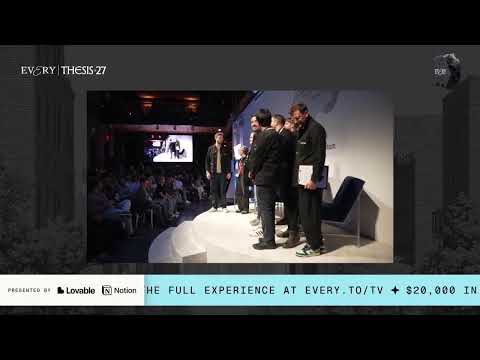
Thesis: 2027 - LIVE from Brooklyn!
A live conference day on the future of work after automation: embodied agents, everyone building with AI, video as interface, context as durable value, and Dan Shipper's argument that human perspective, not default model output, is what stays valuable.
Watch on YouTube ↗Charlie's summary
- ▶ 0:29
Persistent agents like Dot work because they feel familiar: skeuomorphic embodiment solves the empty-box problem
Andrew says he was long anti-embodiment because Codex could do the same tasks. He now sees Dot's coworker-like shape as a bridge, like the leather-and-paper Notes app on the 2007 iPhone. Automations are built in and the thread is single, so it opens with suggestions instead of a blank box. His mother would not use ChatGPT work or Codex, but finds Dot digestible. His team also handed its twelve-a-week desktop release chore to a Dot.
- ▶ 9:10
Bottoms-up culture buys long-term outcomes at the cost of short-term coherence
Andrew says OpenAI has no single person approving every feature. Many people try overlapping things and are “frustrated with each other all the time,” which makes the product hard to coordinate and sometimes cluttered. He thinks it wins on long-term outcomes and calls it high variance. After nostalgia for the simple, fast app of February, he wants every click to take 100 milliseconds.
- ▶ 19:23
Separate a frontier team that tests every new model from the people who ship
An audience member describes how their company handles the pull between shipping and trying each new model. A frontier team with no product responsibilities constantly tests new things and surfaces only what works. Everyone else can ignore each model drop and keep shipping. Andrew's advice to individuals: ask what outcome you are trying to affect, because the tools matter less. Models now let him “change bigger things at once”: “the Legos got a little bit bigger.”
- ▶ 35:08
Nursa gave everyone Lovable after one product built in days, and cut over $1M in spend
Curtis says Nursa's VP of product built a whole new student product with Lovable's agent, and thousands of students now use it though it didn't exist 15 months ago. Everyone in the roughly 160-person company then got access and shipped something. A CPA built a commissions tool and a retired parole officer built a credentialing app. Curtis reports over $1 million in non-headcount opex cut and third-party vendor reliance down more than 80%. His competitive advantages are “speed and context.”
Give your email to unlock the rest of the key points — for every episode.
Do more with Charlie
Free — sign in with your email, no password.