
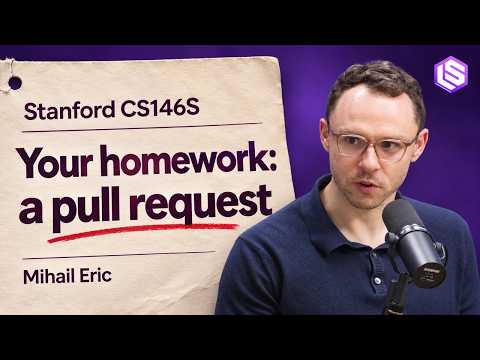
[One Million AI Engineer Special] What Junior Engineers Need to Learn Now — Mihail Eric, Stanford
Mihail Eric argues juniors must now learn agent harness internals, context engineering, agent-ready codebases and review bottlenecks; foundations still matter, the bar is higher, and experimentation beats dogma.
Watch on YouTube ↗Charlie's summary
- ▶ 5:35
The floor is higher for juniors: be near senior level by pairing core software fundamentals with AI-native practice
Mihail says students are anxious, but a well-trained AI-native engineer is among the most useful assets a company can have. The catch is that a new grad can no longer be a junior-level hire; they need to be “almost at the senior level.” He keeps foundational software engineering and system trade-offs as the human value and defers implementation details more often. His course assumes algorithms and basic CS as prerequisites.
- ▶ 10:10
Fix the junior gap with mentorship: make students contribute to real AI-native open source repos
Last year's nine assignments were pedagogical exercises that agents could one-shot. This year Mihail replaced much of that with contributions to AI-native open source projects. Maintainers review the students' code and help build mental models of good software. He worries about a gap between seniors who adopt agents and become amazing and juniors left asking what to do. He sees this as passing on the standard of good design, and some students may get hired from it.
- ▶ 21:15
Stay current by experimenting for ten minutes a day, and treat all of this as unsettled science
Mihail says the course covers open problems, not settled answers. Even people at the frontier have gone far toward dark factories and then reversed course. Asked how to keep up, he says to spend about 10 minutes a day doing something differently, perhaps the same problem with a new tool. That alone, he says, “will cover most of the gap.” He wants experimentation, not dogma.
- ▶ 25:49
A coding agent is a loop you can write in under 200 lines, so teach the harness before the product
Mihail's week one has students build an agent from scratch. With intro-algorithms knowledge you can define an agentic loop that edits files in about 200 lines, without sub-agents or MCP. He then intercepts real Claude Code traffic with a proxy and walks students through the system, plan and compaction prompts, so they see what a state-of-the-art harness does. Most students are only consumers and never peel this back.
Give your email to unlock the rest of the key points — for every episode.
Do more with Charlie
Free — sign in with your email, no password.