
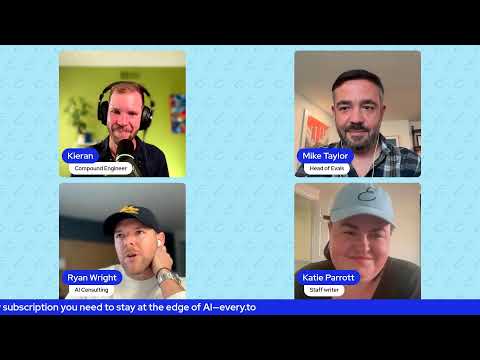
Fable 5.2 Vibe Check
Every's team rates Fable 5.2 a gold-medal, paradigm-shifting model for long-running, ambiguous, high-judgment builds, while Opus 5.5 stays the daily driver and the model stumbles on tightly specified, simple tasks.
Watch on YouTube ↗Charlie's summary
- ▶ 2:01
A gold medal means a model changes how you think about your job, and Fable 5.2 did that for Mike
Mike says he gave gold because the model puts you in a new state of being: you rethink what tasks you can do. Using it for three weeks, he calculated he was doing eight weeks of work in one. When access was pulled and he went back to Opus 5.5, it did better work than before, because his ambition had been raised. Katie called it her career Oscar.
- ▶ 5:04
Fable 5.2 rewards a different way of working: slower, more deliberate, run in parallel, with evals attached
Mike says the model is slower, more deliberative and more expensive, so you must run things in parallel and set up the environment so you can start work Friday and return Sunday to finished results. Kieran adds the dream has to come with evals. Mike's deck task went wrong because the model read only the deck's text, not its images. Give it tools and a way to check its work.
- ▶ 10:44
Jerusalem Bench: given freedom and a day of unattended work, Fable 5.2 produced a walkable, historically detailed 3D city
Katie's prompt asks for an immersive, historically accurate 3D Jerusalem during Jesus's final week. Astra returned a minimal model in 20 minutes, and Argon a text-heavy page without collision. Fable 5.2 ran 24 to 36 hours and delivered a 42-stop tour, period dress, collision, and an enterable Last Supper building. Katie found it a real educational tool. Her read is that it does well when left free to run.
- ▶ 24:50
Ground truth lets the model play-test itself, so ambitious builds like a 3D Battle of New York become feasible
Mike built an Avengers Battle of New York scene in three.js over a weekend. It worked because the model knew the movie, so it had its own eval, and it ran thousands of tests walking around for stuck cameras. Kieran says that at higher effort the model gets better rather than more complicated, and you choose how much to spend. Mike's build cost about $3,000 at API prices.
Give your email to unlock the rest of the key points — for every episode.
Do more with Charlie
Free — sign in with your email, no password.