
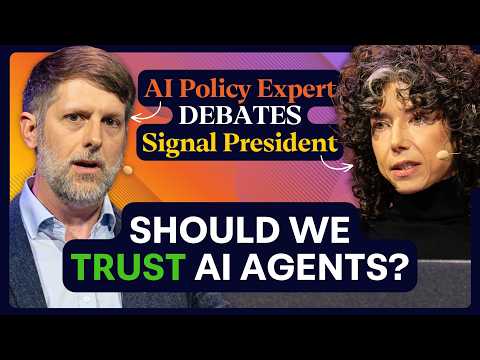
Can you trust an AI agent with your data? (Signal’s Meredith Whittaker debates) | Summit '26
Meredith Whittaker argues consumer AI agents' root access and prompt injection make them untrustworthy, while Neil Chilson says conditional, tiered use and better-built agents can improve privacy over the status quo.
Watch on YouTube ↗Charlie's summary
- ▶ 1:31
Consumer agents need root permissions and obey text as commands, which makes prompt injection a fatal flaw
Meredith says even a simple birthday-party booking needs your contacts, calendar, credit card, browser control and Signal messages. The agent acts without explicit consent and treats text in context as commands, so it can be hijacked. She cites a zero-click exploit on Microsoft's Copilot, a Perplexity browser hacked via a Reddit comment, and an 11% failure rate in Anthropic's Chrome experiment even with guardrails. Her answer on trust: no, but build systems where “trust comes with verification.”
- ▶ 5:05
Agents flip the old internet bargain: your data is used for you, and agents can make privacy convenient
Neil argues that for 20 years companies pulled data to sell ads, while agents let you comb your own data. They can delegate tasks once reserved for the wealthy. Because agents don't get bored, they can read privacy policies and use Tor. He used Muse to block himself on five major data brokers with a six-word prompt. Neil thinks agents can “stand on our side of the glass” and help close windows into our lives.
- ▶ 8:10
These agents aren't yours: Meta's Muse leaked an address and logs your contacts, implicating people who never opted in
Meredith says convenient consumer agents belong to the platform. Muse gave a stranger a Marketplace seller's address, published private company data, and reportedly logs users' contact lists. Anyone in your contacts gets a dossier made about them, “Cambridge Analytica style.” The threat is mild for privileged people in San Francisco, but could be severe for a human rights worker in an authoritarian country. She says installing these tools is “eating the seed corn of our cyber security.”
- ▶ 11:15
Whether to trust an agent is conditional: it depends on the agent, the use and the access requested
Neil says the right comparison is the status quo, not perfection, and that the status quo is poor. He lets his agents read online but mostly not write. His model for progress is messaging: we didn't abandon it when platforms were built badly, we built better ones. He thinks we learn trust by using these products, not by standing back and leaving them to people who don't care about privacy.
Give your email to unlock the rest of the key points — for every episode.
Do more with Charlie
Free — sign in with your email, no password.