
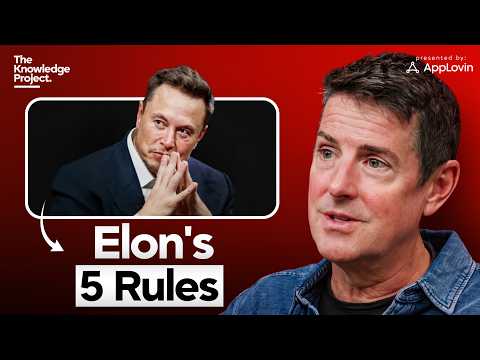
10X’ing Tesla With a $0 Marketing Budget | Ex-Tesla President
Former Tesla president Jon McNeill explains how speed, first-principles simplification, blunt communication and customer closeness let Tesla grow about 10x with no marketing budget, and how he applies those lessons elsewhere.
Watch on YouTube ↗Charlie's summary
- ▶ 3:02
Speed of every kind (decisions, cash, response) is a competitive advantage, and Elon rewards acting without checking in
Elon believes speed of decision-making, of cash through the business and of response time compounds because competitors move slower. Jon's first weeks showed it. He found 10,000 test drives no one had followed up, shut off new leads until reps called them back, and orders poured in. He apologized to Elon for overstepping. Elon replied, “That was a great decision.” Speed is not constant: you work out the problem, then hit “the speed button.”
- ▶ 8:38
Run communication like a dead patient's EKG: go straight across, in three sentences, and bring bad news fast
Most organizations send questions up the hierarchy and back down, producing an EKG-like pattern. Elon wanted a flat line: go directly to whoever has the answer. Jon and Elon also tried running on three-sentence emails: here's my problem, here's my solution, here's my next step (with any ask). Elon's other rule was to give him bad news as soon as you know it, because “bad news only gets worse with time.”
- ▶ 14:40
Fix incentives, but they needn't be monetary: a leaderboard with an arbitrary line got Tesla reps to ask for the sale
Following Charlie Munger, Jon says to understand a system you follow its incentives. Elon didn't want commissions because he didn't want stores to feel like car dealers. Jon's team put a monthly sales leaderboard in every store and drew an almost arbitrary line mid-chart. With no money involved, people worked to get above it, so they had to ask for the order.
- ▶ 16:12
Look for asymmetry, as in poker: take bets with upside asymmetry and remove the downside before taking the others
Elon thought allocating capital is the highest business skill, because it means assessing risk correctly. Jon framed it like poker: for each bet, ask whether the upside or downside is asymmetric. If the downside is, don't bet unless you can remove it. If the upside is, go. This gave teams an easy way to process decisions. Elon wanted an entrepreneur as president because entrepreneurs build that skill.
Give your email to unlock the rest of the key points — for every episode.
Do more with Charlie
Free — sign in with your email, no password.