
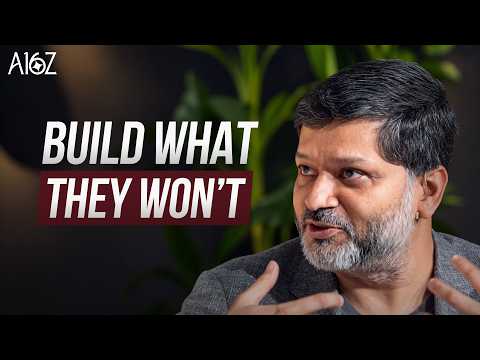
Where Startups Can Win Beyond OpenAI and Anthropic | HubSpot’s Dharmesh Shah
Dharmesh Shah argues that startups can win outside the frontier labs' path by solving whole customer problems in narrow niches, treating AI as infrastructure, and learning cheaply through fast iteration.
Watch on YouTube ↗Charlie's summary
- ▶ 6:39
You can't know an idea's quality in advance, so narrow the aperture and shorten the learning loop
Dharmesh thinks founders wrongly believe an “18 column spreadsheet” can pick the best idea. The only real test is shipping, and the winning business often doesn't resemble the original idea. He urges starting with a narrow market and a first-30-days plan, not a giant TAM. HubSpot began as legal spot, ERP for law firms, before pivoting. The winners have “the shortest iteration time and the cheapest learning time.”
- ▶ 15:23
Solve the whole customer problem, even if advice says do one thing well
HubSpot launched with content management, SEO, landing pages and forms together, against standard advice. Dharmesh says customers were intimidated by fragmentation, so only an all-in-one offering solved their real problem. Its CRM came from a survey showing 60% of paying customers used no CRM. The reasons were intimidation and cost, so HubSpot made the CRM easy and free, creating value before extracting it.
- ▶ 20:58
Build an ecosystem like a product: be an open book and compress developers' “time to joy”
Dharmesh has been on both sides of platforms and saw Twitter go from open to developer hostile. HubSpot tells partners what it won't promise and where it's unlikely to compete, which built trust. He treats developers as customers: just as customers need time to value, developers need a short path from first API call to “I made my first dollar”.
- ▶ 24:32
Avoid ideas that merely fill a not yet gap; pick structural or incentive constraints against the labs
Dharmesh's test: if you can append yet to ChatGPT can't do that and it still holds, the idea is dangerous. Also judge the company, not the product, since OpenAI could launch new product lines. Look for regulatory limits or incentive constraints. OpenAI could target CRM, but the labs' ambition makes it unlikely. He thinks it is less scary to build now than in 2023, since models are becoming infrastructure and are swappable.
Give your email to unlock the rest of the key points — for every episode.
Do more with Charlie
Free — sign in with your email, no password.