
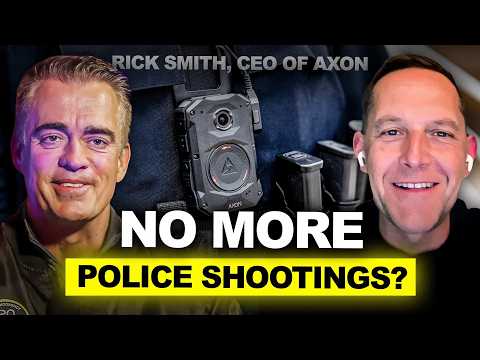
Freedom vs. Safety: Axon CEO Rick Smith on the Future of Policing
Axon CEO Rick Smith argues that non-lethal tools, body cameras and drones, paired with strict data governance and human oversight, make policing safer for both citizens and officers without becoming a surveillance state.
Watch on YouTube ↗Charlie's summary
- ▶ 3:00
Smith started the Taser company from a simple insight: bullets are an old technology and a more civilized option would change choices
Rick came up with the idea in 1993 after European students asked whether he knew anyone shot and killed, and he realized he did. His insight was that with “Captain Kirk's phaser” people would choose not to kill. He found the Taser's inventor through patent filings and built prototypes in the inventor's garage from Ace Hardware parts. Rick says they built the first prototype in 30 days.
- ▶ 7:34
Seven years of failure ended with a pivot from consumers to police, funded by the founder's father's last $500,000
The consumer market failed because the Taser counted as a firearm, so Rick pivoted to police in late 1999 after two failed product launches. When Rick wanted to quit in 1998, his dad said the company owed Silicon Valley Bank about $2 million, so his dad put in his last $500,000 and investor Bruce Culver matched it. That $1 million funded the police Taser through to break-even and an IPO.
- ▶ 10:39
A simple, painless demo won police: pay $100 to anyone who could resist a Taser hit
Earlier non-lethal weapons were seen as snake oil. Rick fixed the product by tuning nerve stimulation until it actually paralyzed people. With no ad budget, he put a former Marine in a Winnebago with a $100 bill to offer officers who could fight through a hit. Officers fell down, got up and saw the value immediately. Rick says the value was so simple they only had to prove it worked, and the company hit break-even within a year.
- ▶ 15:14
Fighting every lawsuit, even settling with its own insurer, left Axon with zero litigation cases
After the 2004 SEC investigation, the stock fell from $33 to $7 and lawsuits multiplied. When the insurer wanted to settle a $2 million case, Rick refused because settling would invite a flood of suits. Axon offered to take a smaller sum and assume the liability itself, did this twice and made money by winning. Rick says Axon will settle if wrong but “dig in like religious fanatics” when right, and now has zero cases.
Give your email to unlock the rest of the key points — for every episode.
Do more with Charlie
Free — sign in with your email, no password.