
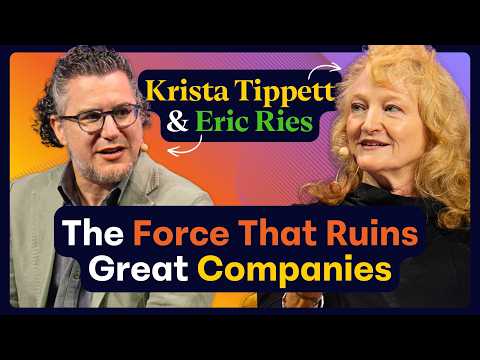
Why good companies go bad (Krista Tippett & Eric Ries) | Summit ’26
Eric Ries argues that scale, not failure, ruins beloved companies, that we should call it corruption, and that trustworthiness and governance, not shareholder primacy, are what let great companies stay great.
Watch on YouTube ↗Charlie's summary
- ▶ 2:02
Scale is what ruins beloved companies, and we should call it corruption
Eric asks audiences for a story where a massive infusion of money made a favorite product better, and people laugh because they have none. He thinks we take extraction at scale for granted, “killing the golden goose on an industrial scale.” Terms like mission drift and bureaucracy undersell the betrayal. Eric argues that making money by destroying value corrupts the moral logic of the economy, and we should stop celebrating it.
- ▶ 4:36
Financial gravity: values flow from those with resources to those who want them
Eric uses gravity as a metaphor for forces beneath strategy and personality that push organizations into the same dismal shape: “Gravity believes in you.” He defines it as the psychological pressure by which values pass from those who have resources to those who want them, like people turning sycophantic around a billionaire. In organizations it shows up as a ghost in the meeting: “the market might not like it,” with nobody having checked.
- ▶ 7:38
Shareholder primacy is a recent idea, not the natural nature of the corporation
Eric says the legal doctrine that a company is just a financial instrument for shareholders is new. In the 19th century you needed legislative permission to incorporate for a specific public benefit, and courts would void a charter if a company strayed. General incorporation came to Delaware in 1899. Eric argues the greatest era of American prosperity fell between general incorporation and the rise of shareholder primacy, so we can go back to purpose-driven companies.
- ▶ 11:11
Costco shows financial gravity is not inevitable, and best practices can destroy value
If scaling inevitably leads to betrayal, Eric asks how exceptions like Costco, Patagonia, IKEA and Novo Nordisk exist. They break conventional best practices. He cites research that since 2008 companies rated as having good governance performed worse for shareholders than those rated badly. Costco has terrible governance by that measure. Eric says we glorify weak leadership, structure and culture, and leaders should be open to having been taught an error.
Give your email to unlock the rest of the key points — for every episode.
Do more with Charlie
Free — sign in with your email, no password.