
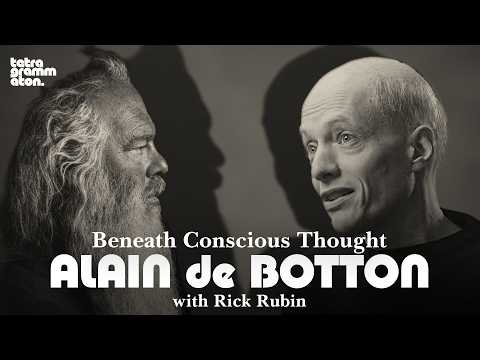
Rick Rubin and Alain de Botton on the Hidden Intelligence of the Mind
Alain de Botton argues that much of our best thinking, creativity and emotional life runs beneath conscious awareness, and that envy, therapy, silence, art and religion are ways of listening to it.
Watch on YouTube ↗Charlie's summary
- ▶ 0:45
Think in fragments and hang a sign: a book's title works like a butterfly net for scattered ideas
Alain says nobody thinks in 300-page units. We think in fragments, and the work is asking what wider idea a fragment belongs to. Often he starts with a title, such as a case about love or death. Then, like “a butterfly net”, it draws in thoughts that would have landed elsewhere. He also lets unfinished ideas ferment for years in notebooks, and later finds most fragments a home.
- ▶ 17:06
Envy is a signpost to your hidden potential: do archaeology on it instead of suppressing it
Alain notes he envied some people and felt nothing for others, which made him curious. He thinks envy warns us about what we lack and often points to potential not yet understood. We usually envy a whole person, but he suggests sifting through it, like a broken pot, to find which pieces matter. His example is the freedom and playfulness he felt at a David Hockney show. Use envy rather than being ashamed of it.
- ▶ 22:43
Failure is not sharing the work: success begins the moment you show it
Alain is shy about the visual objects and rooms he designs privately. He argues that people should be given a chance to start in a new art form, and that failing is acceptable when starting from scratch. The only real failure, he says, is not sharing. If you would show it to a friend visiting your home, you are ready to show it to strangers.
- ▶ 25:17
Ask yourself what you really think: the unconscious often knows before the conscious mind
Alain says our minds are far ahead of our consciousness. In a choice between A and B, the unconscious has often decided while consciousness hinders. He suggests asking not just what the answer is, but what you really think, and waiting for an answer from somewhere other than daily awareness. In relationships this can reveal the fear behind apparent numbness, such as being abandoned. Freud's fundamental rule of saying whatever comes to mind was meant to unlock this.
Give your email to unlock the rest of the key points — for every episode.
Do more with Charlie
Free — sign in with your email, no password.