
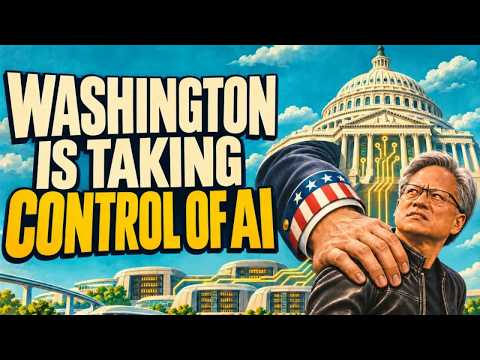
Washington Fired Jensen Huang
Jensen Huang's exit from Nvidia has become a turning point for Washington: it strengthens China hawks and export-control legislation, while the spy narrative weakens and Nvidia's role as AI's financier is in question.
Watch on YouTube ↗Charlie's summary
- ▶ 0:59
Washington effectively fired Jensen: the exit opens a period of Democratic power and hawkish China policy.
NLW argues that, setting aside theories about a coordinated campaign, the resignation looks like the opening shot of a new era. Democrats are asserting power over foreign policy and over powerful private companies, and China hawks are ascendant. The House China Committee chair said Nvidia must appoint leadership that makes “national security its top priority.” Speaker Johnson and Senate Majority Leader Thune both signaled export controls are now likely to pass.
- ▶ 2:59
Export controls were already headed for the must-pass defense bill, and the scandal has put them at the top of the agenda.
Chip controls were expected to ride on the National Defense Authorization Act during the lame duck session. A congressional aide told Politico that Republicans know the next version “gets written by Democrats” if they don't deal now. Brian Mast said the week 100% boosted the chances of all three chip control bills, and that the White House is helping.
- ▶ 4:01
The chip debate is musket versus machine gun on one side, and a simple don't give them chips on the other.
Gavin Baker argues that selling China older chips keeps it structurally behind under scaling laws, and that the hawks' policy could push China toward its own hardware. NLW notes that Jensen's side rarely framed it as a way to compete with China. Dmitri Alperovitch's counter is simpler and falsifiable: arming China produced models under nine months behind, so try the opposite. NLW thinks that is politically more resonant.
- ▶ 8:37
Slowing US data centers and denying China chips can be coherent policy together.
Gary Ying of Natixis says a US slowdown could be a win for China, since high US token prices would let China export cheap inference backed by abundant electricity. NLW notes this casts denying China chips in a new light. Other voices compare the scandal to the Klaus Fuchs atomic spy case and see a Cold War mentality spreading, though the executive branch keeps wide latitude.
Give your email to unlock the rest of the key points — for every episode.
Do more with Charlie
Free — sign in with your email, no password.