
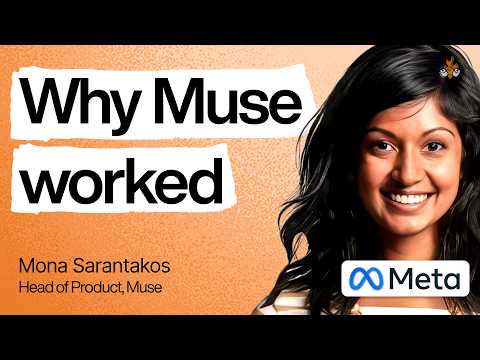
Meta’s Muse: How we launched the most successful consumer product this year | Mona Sarantakos
Mona Sarantakos explains how Muse went from a weekend OpenClaw experiment to a hit consumer agent, by gating launch on trust, keeping the team tiny, and holding a high bar for product taste.
Watch on YouTube ↗Charlie's summary
- ▶ 2:30
Muse began as a weekend experiment, not a mandate: a ping from Nat Friedman and a Raspberry Pi
Nat Friedman pinged a few people about OpenClaw. With no Mac Mini available, Mona set it up on a Raspberry Pi and spent the weekend talking to it. By Monday it had pulled her school newsletters into a snapshot of the week, which “felt pretty magical” from a tiny prompt. She thought of how many busy parents feel the same way and was in. There was no pitch or official project. A few people peeled off to prototype, and a team formed once it was clearly a product.
- ▶ 9:43
Trust is a must: Muse waited seven months because reliability, safety and security set the launch bar
Mona says the team could have shipped earlier. But Muse holds personal context and can buy things, so benchmarks weren't enough and the team built its own eval bar and red-teamed heavily. Each new feature, like the browser, opened new security vectors to close. Her reasoning: launch early with a bunch of issues and people stop trusting the agent, and then they never use it. She wouldn't change the timing, and so far there has been no catastrophic problem.
- ▶ 16:18
Leadership worked as prototype-in-hand conversations, and Mark's alignment reframe shaped the product
Mona skipped formal reviews and slides. The team handed Mark a phone and asked what he thought. Mark said Muse exists to help people achieve their goals, which pulled the team out of a narrow focus on task completion. The key question became what the user is trying to do and what their priorities are. That opened up the proactive ideas the team calls dreaming and study, and led to the goals tab. Nat shaped the security architecture, and Alex pushed the team to launch.
- ▶ 23:26
Jolly is the cockroach: a placeholder avatar survived because a personal agent shouldn't wear a corporate logo
Jolly started as designer Alex Cornell's one-shot prototype creature. People kept saying a stuffed animal couldn't ship at the top of the product. But once it was there, the team built animations and then user-chosen avatars around it. Mona's reasoning: when you talk to something so personal, “the last thing you want to talk to is a corporate logo.” She says the product principle is that Muse belongs to you and Meta should fade away. Her lesson for PMs is that you have agency, so say what you want.
Give your email to unlock the rest of the key points — for every episode.
Do more with Charlie
Free — sign in with your email, no password.