
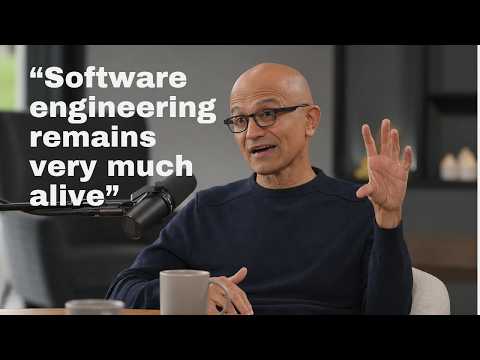
Software engineering after code becomes cheap with Satya Nadella
Satya Nadella argues that when code generation is cheap, verification, specs and owning your own AI stack become the hard, valuable work, and that engineers should learn by doing in the new tool chain.
Watch on YouTube ↗Charlie's summary
- ▶ 6:33
AI-first product building is unforgiving: when model jumps are nonlinear, the form factor must change, so don't be in love with what you built
Satya explains why Microsoft was caught off guard when the IDE faded in about six months. Copilot began with code completions, Cursor forked the IDE and led on agent mode, and then Anthropic's model made the CLI the form factor, taking work from input to output. Satya says you must build around a given model and be ready to rewire for the next one's emergent capabilities.
- ▶ 9:37
Decision engines are a new primitive, the stored procedure of the intelligence era
Satya likes decision engines because intelligence becomes an embedded function rather than code regenerated each time. His example is an Xbox system for community feedback: it only needs to make decisions, so it doesn't need LLM code generated again and again. It is token efficient and has a distribution you can call. He likens it to Excel macros and relational databases, and thinks software engineering stays alive through such primitives. He may even see an IDE rebirth.
- ▶ 12:42
When code generation is cheap, verification becomes the hard part
Satya says code as output has a particular order of operations, not random generated code. Teams must build verification: turn every failure back into a test case and confirm the test is real. He calls this new tribal knowledge. He points to a Rust migration that had to be reverted as a sign of the risks, and says he would love to join one of these teams himself.
- ▶ 15:44
The software factory moves code from input to output, so specs, intent, critique and production traces matter most
As Satya understands it, a software factory makes specs and intent the input. Everything is documented, so onboarding onto a codebase is far easier. Tasks are small and verified, with a critique from a separate model family so one family's flaws don't become yours. Production traces feed back to verify fixes. Azure networking built an agentic ops system for roughly 500 fiber operators, connected to its repos.
Give your email to unlock the rest of the key points — for every episode.
Do more with Charlie
Free — sign in with your email, no password.