
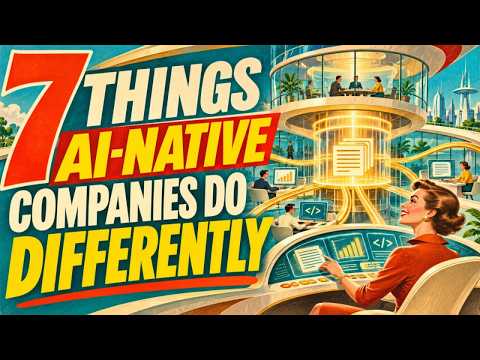
7 Things AI-Native Companies Do Differently
AI-native companies share seven practices centered on managing context, signals, orchestration, verification and accountability, and the host argues that treating agents as teammates is the wrong mental model compared with on-demand consulting firms.
Watch on YouTube ↗Charlie's summary
- ▶ 3:33
Give agents the whole picture: context, not the model, is the limit on meaningful knowledge work
The host says the limit is usually the context and systems a model can reach, not the model. Odyssey's Francis Davidson called his approach context maxing: agents get MCP or CLI access to every meeting recording, Slack, email, drive and tool. Ramp runs a daily pipeline into persistent memory, and Uber built a context graph from more than 30 systems. This layer must be kept current, since Ramp's analyst agent gets worse when it goes stale.
- ▶ 5:34
Employees who fear for their jobs hoard context, which makes context sharing a cultural problem
George Savoca of Hebbia found that employees unsure about their future hoard context as job security. If you know what your value is, why would you hand it to the agent? The host calls this a cultural problem more than a technical one, and thinks leaders will have to face it head-on.
- ▶ 6:04
Put agents in every function, not just engineering
The host argues that being AI native means the whole organization, not only engineers. Anthropic's growth marketing team has been a single person using agent workflows that read CSVs of hundreds of ads, flag underperformers and write hundreds of new ads in minutes. Examples from OpenAI's research include Basis running onboarding, Clay running account management, and Exa running developer ecosystem growth.
- ▶ 7:05
A signal, not a prompt, should start the work
In AI-native companies, work begins from a trigger such as a customer message, invoice, renewal or alert, rather than a human prompt. At Uber, most agent sessions are now started by other agents for code review, self-healing CI and on-call triage. The host suggests asking which events in your business, like a churn signal or renewal, should start work automatically.
Give your email to unlock the rest of the key points — for every episode.
Do more with Charlie
Free — sign in with your email, no password.