
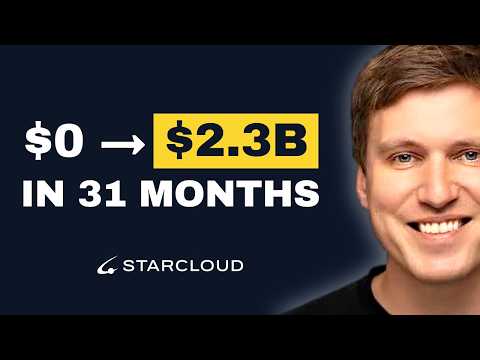
Why AI Is Moving to Space | Philip Johnston, Starcloud
Philip Johnston argues that orbital data centers will become the cheapest way to run AI once launch costs fall below $500 per kilo, and Starcloud is building the technology now through government edge-compute work.
Watch on YouTube ↗Charlie's summary
- ▶ 0:00
Space becomes the cheapest place to run AI once launch costs drop below about $500 a kilo
Philip says space is not cheapest today. Falcon 9 costs about $5,000 a kilo, and break-even needs under $500, which needs Starship-class vehicles. In space you skip permitted land and batteries, and one square meter of panel yields about eight times the annual energy. Launch is the main added cost. Starcloud is building the technology now, funded by cloud and edge services for government and military satellites.
- ▶ 12:18
Fly on the terminator line: constant sun means no batteries
Starcloud's planned satellites fly a dawn-dusk sun-synchronous orbit over the poles, staying on the line between day and night. Because Earth is slightly oblate, the orbit rotates about 1/365th each day and tracks that line all year. The craft never enter Earth's shadow, so only a small buffer battery is needed. Batteries are heavy and expensive to launch. Philip says the trailing band also means far fewer collision-avoidance maneuvers than Starlink.
- ▶ 17:39
The cooling objection fails: space is a vacuum, but radiators work, as the ISS shows
Philip walks through the layers. Space is cold but a vacuum, so heat leaves only as infrared. Radiated power scales with the fourth power of temperature, so raising radiator temperature from 50° to 80° cuts the needed area by close to half. The ISS has run the same liquid-loop radiator for 20 years. Starcloud says its in-house radiators have about 10 times less mass per watt and about 500 times less cost per watt than the ISS's. Philip calls the challenge manufacturing, not physics.
- ▶ 23:04
Starcloud built for $2.5M what a defense prime quoted at $75–100M
A prime quoted $75 million to $100 million for the program. Starcloud-1 cost $300k for launch, $1M for the bus and about $500k for the payload. Philip blames cost-plus R&D and the belief that an H100 couldn't run in space. Two engineers hand-built the payload: an immersion-cooled H100 in phase-change material, with two fully independent systems. The 60 kg satellite is still running government workloads.
Give your email to unlock the rest of the key points — for every episode.
Do more with Charlie
Free — sign in with your email, no password.